Inception: The Making of the Right

By Rodolfo F. Acuña

I just finished watching a surreal film that reminds me of Arizona. The difference is that you cannot alter the xenophobes’ dreams by entering the REM (Rapid Eye Motion) stage of their sleep and repair their character.

Hence, there is no hope for the Arizona nativist cabal who are permanently trapped in their dreams and illusions. They are addicted to their dreams; they are prisoners of their dreams; and jolts of reality or humanity will not awaken them.

I have tried to understand their obsession with hunting down the “replicants.” I have traded barbs with Glenn Spencer, the founder of Voices of Citizens Together and the American Border Patrol who after the passage of California’s Proposition 187 moved to Arizona “to secure our borders.”

Spencer ranted about his patriotism and love for America. One day out of the blue I asked him if he had ever served in the military. Spencer stuttered and responded that he had had other obligations.

In my family, if you believed in something you fought for it. You never espoused a course of action for others unless you were willing to do it yourself.

The last time I heard, Spencer was at his Sierra Vista, Arizona ranch, still ranting about the Second Mexican American War, assisting his Minuteman pals. Running around in fatigues and playing soldier is an awful lot safer than being a real soldier.

It cannot be assumed that all xenophobes are gunslingers like Sheriff “Joe” Arpaio or failed politicians and businessmen like Tome Horne. Many racist nativist are educated, although some like Pat Buchanan have forged a cottage industry in bashing immigrants.

It is difficult to understand Buchanan’s brand of racism. He wears his Irish heritage on his sleeves but he makes the same reckless accusations of today’s immigrants that were made about his ancestors. Reading the works of John Higham and Ray Billington on American Nativism, the historic pattern of violent nativism is unmistakable.

In 1834, an anti-Catholic mob burned down The Ursuline Convent in Charlestown, Massachusetts. In 1844, mobs in Philadelphia, Pennsylvania invaded Irish Catholic neighborhoods and burned down two Catholic Churches. They killed at least fourteen people, injured an estimated fifty people, and drove two hundred from their homes.

Dreams and illusions are part of the mob’s mentality. The normal stage of sleep characterized by REM may have been short circuited. REM sleep supposedly consolidates procedural and spatial memories. However, this state has been blurred in the racists’ minds and their illusions have taken over—it cannot be repaired.

Recently I had an exchange with a Matthew Richer, a resident of the Boston, Massachusetts area. Richer was evidently disturbed by an article that I had written about Arizona. I labeled the article “Rough Draft” since I write those pieces more as blogs rather than finished products— I don’t get paid for them.

I always remember Harry Gamboa Jr words that many artists have poor techniques but important messages, while others have great techniques but no message.

Richer’s claims to fame are few—an article in the Policy Review on “Boston’s busing massacre,” he was once a graduate assistant at Columbia and he now writes for the web site VDARE.

Richer was presumptuous enough to question my take on the evolution of fascism, believing that I would defend my historiography because he demanded so. It was evident during the exchange that although he was a literature major, Richer had absolutely no grasp of historical or sociological literature.

At one point the discussion became ridiculous with Richer claiming that Boston Jesuit School was better than Loyola because Loyola had been corrupted by affirmative action. The reality was there was no affirmative action when I attended Loyola High.

Richer is also living the illusion that he is an intellectual, claiming that William Buckley Jr. was not the intellectual leader of American conservativism; by inference he and his cabal were the leaders of the white rabble.

For as much as I disagreed with Buckley and his National Review, they were rational. Having read Richer and VDARE, I can say that Richer is no William Buckley Jr. and VDARE is no National Review.

The similarities between Richer and Spencer are striking. They are super patriots who live life behind desks never having served in the military while championing war and stereotyping whole races of people. They lack a historical sense and are driven by their pretensions.

One can imagine the Tea Partiers as the campus bullies while Richer and Spencer lived in dread of minorities, secretly admiring the bullies who sometimes played sports and were part of the “Mean Boys.”

People like Richer cope with their mediocrity by developing historical amnesia, attempting to rewrite history. Richer forgets the old expression that he learned in grade school, “There but for the grace of God, go I.”

It must be a blow to his ego that after all his opportunities and the money his parents paid for him to attend Boston College High School that he is reduced to writing blogs for VDARE—hardly a peer reviewed journal.

Like I said at the outset, our dreams help form our reality. Rather than living an illusion, for example, I want to be like Segismundo, the protagonist of Pedro Calderón de la Barca La Vida es Sueño, who fears awakening and being put back into the tower for his transgressions.

If they weren’t so damn destructive, I would pity the racist nativists. All their hopes and illusions dashed by their mediocrity. When they die, not even their spouses will miss them. Scholars in years to come will dismiss them as those “no nothings.”
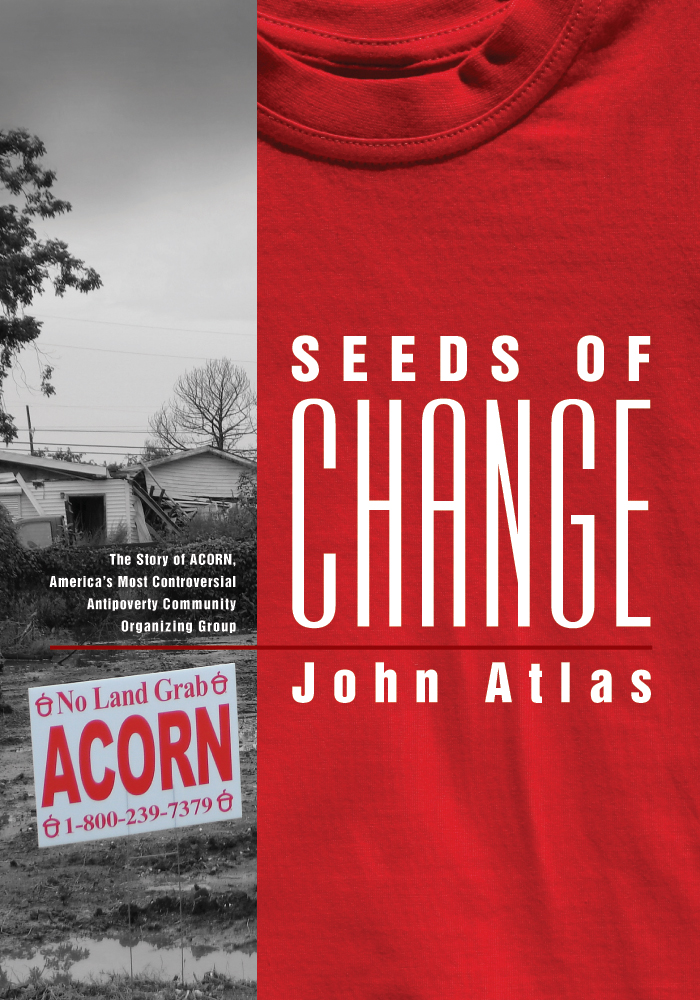
Seeds of Change: The Story of ACORN, America’s Most Controversial Antipoverty Community Organizing Group [Book Note]

By John Atlas

“There is more value on a single page of Seeds of Change than in a year’s worth of Rush Limbaugh screeds combined with a lifetime of Sarah Palin sneers at community organizers.” –Todd Gitlin

Seeds of Change goes beyond the headlines of the last Presidential campaign to describe what really happened in ACORN’s massive voter registration drives, why it triggered an unrelenting attack by Fox News and the Republican Party, and how it confronted its internal divisions and scandals.

Based on Atlas’s own eyewitness original reporting, as the only journalist to have access to ACORN’s staff and board meetings, this book documents the critical transition from founder Wade Rathke, a white New Orleans radical to Bertha Lewis, a Brooklyn African American activist.

The story begins in the 1970s, when a small group of young men and women, led by a charismatic college dropout, began a quest to help the powerless help themselves. In a tale full of unusual characters and dramatic conflicts, the book follows the ups and downs of ACORN’s organizers and members as they confront big corporations and unresponsive government officials in Albuquerque, Brooklyn, Chicago, Detroit, Little Rock, New Orleans, Philadelphia, and the Twin Cities.

The author follows the course of local and national campaigns to organize unions, fight the subprime mortgage crisis, promote living wages for working people, struggle for affordable housing and against gentrification, and help Hurricane Katrina’s survivors return to New Orleans.

The book dispels the conservative myth that we can only help the poor through private soup kitchens and charity and the liberal myth that the solution rests simply with more government services. Seeds of Change, not only provides a gripping look at ACORN’s four decades of effective organizing, but also offers a hopeful analysis of the potential for a revival of real American democracy.

Fred Collins, 48, Dies in a Hail of Bullets After Taser Gun Fails: Cops Kill Again in Oakland

By DENNIS BERNSTEIN

Here we go again: last Saturday, July 19, another police kill at the same rail transit station in Oakland, California, where 22-year-old Oscar Grant was shot in the back last year.

And while the circumstances of Saturday’s early morning police shooting are very different from those in the Grant case, there are many questions that need to raised about a violent police over-reaction.

On Saturday, Oakland and Bay Area Rapid Transit police shot and killed a reportedly “Hispanic looking” man near the Fruitvale station in Oakland. The first reports, all from the police, said the man was “armed,” wielding two knives.
The dead man was not identified until Sunday, when an OPD spokesperson gave his name and age as Fred Colllins, 48. None of the dozens of officers who answered the call were hurt during the incident.

According to police officials, Oakland homicide detectives, the Alameda County District Attorney’s Office, and the internal affairs units of the Oakland and BART police departments are conducting administrative investigations into the shooting.

An eyewitness, looking out her window, said the man was walking backwards yelling for the police to shoot him. According to a television interview with the eye-witness, the man had his hands up.

Ultimately, the man died in a barrage of police bullets – at least five cops shot him down. Dozens of cops were on the scene. Given the number of shooters, it may never be known which bullet killed the man.

The description given by several eye-witnesses does not appear to square with the police decision to cut the man down with a hail of bullets, from at least five guns. Police claim they tasered the man several times but it didn’t have any effect. Then he came at them with a pair of knives.
Here’s what one eye-witness was filmed saying to local TV. Again she watched it out the window of her house in Fruitvale, a short distance from the rail station:

“When they turned here at the corner, there was, I want to say, about 10 policemen, all gathered together. And then I saw this man walking backwards, like this (both hands up), saying, ‘Shoot me, shoot me, shoot me’! And the police, I didn’t hear none of the police say anything. They were just gathered together, following him while he was walking backwards all the way through that street,” said Letty, who did not give her last name. “And then all of a sudden, I hear a little pop and then right after that I hear bup, bup, bup, bup, bup!”

The BayCitizen reported, according to eye-witness interviews, that the man was wearing two backpacks – one on his back and one on his front, and was shot after he tried to reach inside one. Police say nothing about a backpack.
Fourteen-year-old Florencia Osores told the BayCitizen that she watched the shooting out her window with her family. Osores said she saw about “15” cops in pursuit. The man stopped running and turned around.

“The cops said, ‘Stop!’” she said. Collins turned his back to officers and “looked like he was taking something from his bag.” According to the teen eye-witness, that’s when the cops opened up with a barrage of fire. “I’ve never seen the cops versus a person before,” she said. “They shouldn’t be trying to kill him. Couldn’t they have shot him in the leg?”

Mesha Monge Irizarry knows a great deal about police overreaction and a lot about the nature and impact of the 50,000 watt taser the police claim was ineffective in stopping their alleged suspect.

Over the years, Irizarry has given courses to the police in non-violent escalation, but in a tragic twist of fate saw her own 23-year-old son, Idriss Stelley, a 4.0 college student, go down in a barrage of 48 bullets in 2001.

“I have thoroughly studied this. It’s a common practice for police to all starting firing at once,” said Irizarry. “They know when they shoot together, it’s almost impossible to find out who shot first or whose bullet ended a life.”

She says she’s extremely suspicious about the police claims that the taser didn’t stop the man or even slow him down.

“There’s no such thing as it doesn’t have any effect, like the police are claiming. They’re full of bull. It’s not like a little shock from a faulty circuit. It totally shuts your body down. Many people have died from one application.”

Irizarry volunteered to be tasered in 2006 during an international human rights gathering in San Francisco. “It takes you out for a full seven seconds. That’s when the police are supposed to act” to subdue a person.

James Keys, chair of San Francisco City and County Board of Mental Health, also has grave doubts about the police claims that the taser had little or no effect. “I find it hard to believe that they shot him like that with a taser several times and he kept going … That amount of voltage [makes it] hard to believe.”

Keys says that OPD has failed “for decades in with dealing with situations like this … I cannot understand why they couldn’t subdue that man without using a kill shot. There are many other ways.”

The local NBC news affiliate reported that “witnesses in the area said the man kept crying that officers shot him” with a taser.

Keys, who grew up in Oakland, said the problem is bigger than crisis intervention. He said the OPD doesn’t have the trust or the support of the community, and people of color are not going to be rushing to turn themselves in, in order to become the next Oscar Grant.

“I grew up in Oakland as an African American … and the police have never dealt well” with Black and Brown people. “The prevailing attitude is that white officers kill” people of color. “That’s the mindset: People are afraid of the police in Oakland.”

Keys was disappointed in Mayor Dellums’ actions around both the killing of Oscar Grant as well as his willingness to jump on the bandwagon with the police department, when he should be more of a “joiner,” bringing people together rather than immediately siding with the police.

Mayor Ron Dellums released a statement on Saturday afternoon – a “joint news release” on the shooting, on behalf of the Oakland Police Department, the Mayor’s Office and BART officials – urging calm but voicing little concern about the pattern of violence and over-reaction shown by BART and Oakland police.

“Anytime there is a loss of life, it is a matter of great concern and sadness for us all,” Dellums said in his written statement. “It is extremely important that we as a community continue to work together in order to provide a safe and secure environment. Therefore, a thorough investigation of the circumstances surrounding this death has begun.”

BART also announced a “thorough” investigation into the shooting. “The loss of life under any circumstance is truly an unfortunate and regrettable event,” wrote BART Vice President Bob Franklin and board member Carole Ward Allen in the joint statement.

“The BART Police Department is cooperating fully with the Oakland Police Department who has the lead in the investigation into today’s officer involved shooting. We have immediately launched a separate but parallel administrative investigation as well to ensure this incident is thoroughly investigated in a transparent manner.

There is “something wrong at the core,” says Irizarry. It’s about the police abuse of power, and their decision, all too often, to use force over reason.

The police in Oakland and the BART Police “should be the last to be called,” she said. “Why isn’t the mayor talking about crisis intervention teams, instead of sending cops out who have no training in intervention with distraught people, who are not trained in crisis de-escalation … Calling the police to do a non-violent intervention with a troubled person is like calling the mortician to deliver a baby.”

“People are very scared,” local resident Juanna Nieva told one reporter. “I am really worried for kids. People are living in fear in Oakland.”

Now the question for many people of color in Oakland is: Are they more fearful of the criminals or of the cops who are supposed to protect them?

Dennis Bernstein is an investigative journalist who hosts Flashpoints, heard on KPFA 94.1 FM weekdays at 5 p.m. and archived at www.flashpoints.net and www.kpfa.org. He can be reached at dbernstein@igc.org.

Source: counterpunch.org