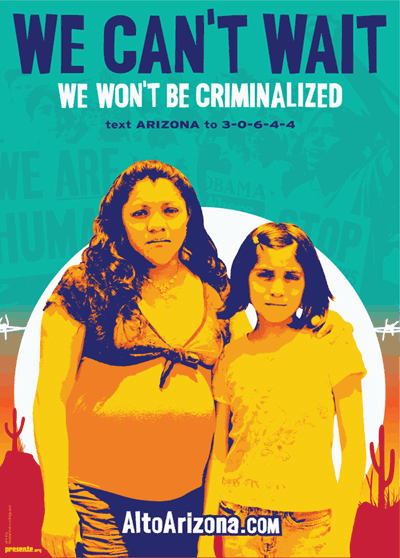
Arizona: The Death of the Fourth Estate

By Rodolfo F. Acuña

The press in theory is supposed to safeguard democratic principles. During a parliamentary debate in 1787, Edmund Burke supposedly referred to the press corps reporting the activities of the House of Commons as the Fourth Estate. Hypothetically the press was the champion of the public.

According to its supporters, the Fourth Estate acted as a mediator between the public and the elite. Journalists listened to and recorded the activities of those with power. An enthusiastic John Dewey believed that the public was capable of understanding and discussing policies and should be part of the public vetting process. Thus, the press would provide a forum where the people could weigh the consequences of policies being considered by those who governed.

Hence, the journalist’s foremost duty was to tell the truth. But, over the years there has been an erosion of the public trust in the Fourth Estate, as the media has been monopolized by those President Franklin Roosevelt in 1936 called economic royalists that control the country.

President Roosevelt summed up this process of the monopolization of society saying, “New kingdoms were built upon concentration of control over material things. Through new uses of corporations, banks and securities, new machinery of industry and agriculture, of labor and capital – all undreamed of by the Fathers – the whole structure of modern life was impressed into this royal service.”

The Arizona media is the worst example of an institution abandoning its mission to educate the public. On the current immigration crisis, the media’s coverage of SB 1070 has been spotty both inside and outside the state. Regarding HB 2281 that outlaws ethnic studies, the media has been mute with the news either distorted or not reported.

I learned recently from two reporters that new editors around the state had directed their staffs not to cover opposition to the laws. For example, coverage of civil disobedience by students has gone unreported.

In order to shine a bright light on what is happening I contacted several Chicano journalists. A respected journalism professor wrote of Arizona: “As you well document and others have also, in recent years Latinos have been unfairly targeted, scapegoated and vilified by much of the general audience media, not just the usual right wing targets. This isn’t the first time, as we both know from our long work in this area. But at a time when the ‘mainstream’ media are steadily losing audiences, they seem to think they can build a more credible news report by either ignoring or misrepresenting the largest and fastest growing segment of the population….”

The problem in Arizona and indeed in most of the country is nothing new—it is systemic. As the traffic of undocumented Mexicans and others increased through southern Arizona in the 1980s and 1990s due to federal policy changes, the issue of immigration was politicized. Border Patrol sweeps in El Paso and San Diego channeled the traffic of undocumented Mexicans through southern Arizona, forcing many to brave the hazardous desert of southern Arizona. In this atmosphere many of the ranchers took the law into their own hands, hunting down Mexicans, entreating others to join them in the hunt.

Beside herself, Professor Guadalupe Castillo of Pima College in 1980 asked a New York Times reporter, why the national media was so silent, he responded, “The border is a Third World country, and people just don’t give a damn.”

The silence of the press encouraged Patrick Hanigan, his brother, Thomas, and their father, George, in August of 1976 to round up three undocumented workers, who crossed their ranch, which fronted the Mexican border west of Douglas, Ariz. The Hanigans tortured them, using hot pokers, cigarettes, and knives and fired a shotgun filled with bird shot at them. The ordeal lasted several hours before the Hanigans sent the three workers naked and bleeding back across the border.

An all white jury acquitted Patrick and Thomas Hanigan in 1977 of fourteen counts of assault, kidnapping, and other felonies. Their father died before the trial. A public outcry led by Chicano organizations forced the Jimmy Carter administration in 1981 to try the Hanigans on civil rights violations. A federal jury found Patrick guilty. Thomas, because of his young age, was acquitted. At least fifteen killings and more than 150 incidents of alleged brutality occurred against Mexicans in Arizona alone during the 70s.

In 1981 another all-white jury in Arizona state court found a former rancher, W.M. Burris Jr., 28, guilty of the unlawful imprisonment and aggravated assault of a Mexican farm worker. Burris suspected his employee of stealing, so he chained the worker around the neck. The jury, however, found him not guilty of the more serious charge of unlawful imprisonment and kidnapping.

The most obnoxious wanna-be ranger was Roger Barnett, who boasted that he made thousands of arrests of Mexican migrants on “his ranch.” Barnett and his followers sent out a racist flyer inviting white supremacist groups to come help them “hunt” Mexican “aliens.”

During these three decades, a reasonable person would have expected the Arizona media to inform Arizonans about civil behavior. Instead they have been intimidated by those who shout the loudest. They have betrayed their public trust and not had the courage of their convicts.

Edward R. Murrow must be turning over in his grave. The media has abrogated any duty to objectively inform the public. For instance, Arizona just passed a law allowing almost any adult to carry a concealed or unconcealed weapon for any reason — with or without a permit. The media has refused to take a position.

However, I wonder what the position of the media would be if Mexicans, Latinos and African Americans started showing up at rallies with guns strapped to their waists?

Occasionally the media gets it right. Recently, New York City Mayor *Michael Bloomberg** *and News Corp. CEO *Rupert Murdoch advocated* the securing of the border, but also called for providing a path to legal status for all undocumented immigrants. Neither is a liberal but they recognized good economic policy. The news conference was mentioned by the press and then dropped; the electronic medic was even less probative.

Clearly the Fourth Estate is no longer a factor in American life. It does not want to offend the Burrises and Barnetts of Arizona. Hence, as Roosevelt foresaw “the whole structure of modern life was impressed into this royal service” with the media serving clients and investors.

Poster By: Favianna Rodriguez

Todos Somos Los Medios!: Voices from the US Social Forum 2010

By Francisco Romero, RPMA Media Team

“We understand clearly that we (as activists, artists, community organizers, media makers) are the change agents we have been waiting for.” (USSF 2010)

(Detroit, MI) For this year’s U.S. Social Forum, the Raza Press and Media Association (RPMA) , along with our allies at the Xicano Development Center’s (XDC) program Radio Free Aztlan , embarked on a tireless five day joint collaborative media project. With over 15,000 in attendance and 1,086 workshops, the U.S. Social Forum served as an organizing space for sharing of ideas, strategies, tactics and overall plans of action to build and enhance the grassroots social movements confronting “deeper and more pervasive poverty world-wide, unsustainable industrial and developmental practices that accelerate global warming, massive displacement of communities due to trade and economic development, and and rampant speculation in speculation in financial markets” that have led the the economic crisis that exist today.

With so many participants, it could be very easy for a voice to be lost in the abyss of the global intertwined network of resistance. So, to that end, the RPMA and the XDC prepared and coordinated an organized effort to document and share the unique lessons voiced by those in rebellion, in resistance, in struggle, be it the fight against wars of aggression and militarization, the struggle for self-determination and liberation, the on-going battle for “work, land, housing, food, health care, education, independence, freedom, democracy, justice and peace.”

THE PEOPLE’S MEDIA CENTER
Hundreds of media workers gathered and set up working stations at the People’s Media Center (PMC) on the second floor of the COBO Exhibition Hall and Conference Center, the central U.S. Social Forum 2010 meeting space. The USSF 2010 stated. “The People’s Media Center (PMC) at this year’s US Social Forum in Detroit seeks to keep up with this evolving media landscape and once again break new ground in changing the relationships between media, cultural workers and the movements they cover. The People’s Media Center will serve not only as a hub for traditional, new and people’s journalists in this new media world to connect and share, but also a space for many story-telling, cultural and artistic activities to take place continuously and throughout the forum.” The Raza Press and Media Association, shared a working space alongside, TeleSur, Democracy Now, Real News Network, IndyMedia, Free Speech TV, among dozens of others.

The role of grassroots, independent media was extremely important at this year’s USSF 2010, having that the mass corporate media seen the forum as “disregarded marginal and irrelevant — that is, if they’re regarded at all?” (AlterNet) Where else was there such a mass convergence taking place? The FIFA World Cup 2010 spectacle overshadowed the U.S. Social Forum and the protests of the G-20 in Canada.

In short, if it were not for the humble efforts of a handful of committed media activist/organizers, the U.S. Social Forum 2010 could have easily been forgotten. The reality is that we exist and resist, with innovative “Up-to-the-minute radio, print and video reports produced through the center and broadcasting on partnering networks; fed to local and national media outlets; and published on social networks, blogs, websites and portals all across the US and the world. With daily press briefings and a diverse speakers’ bureau, the center will also seek to connect grassroots organizers and leaders with mainstream journalists to generate widespread coverage of the ideas, events and people of the USSF.” (http://www.ussf2010.org/pmc)

THE DETROIT PAPERS
It was nearly seven years ago on September 20, 2003, where a handful of media activists convened at the RPMA’s Summit entitled, “Develop the Means to Wake Up the Masses-Become Part of History-Help Build an Independent Raza Media Association”, in the small community just outside of Detroit, in the town of Ypsilanti, MI, at Eastern Michigan University. At this summit, participants discussed, debated and adopted a resolution of four sections that would lead the then Raza Press Association (now Raza Press and Media Association) into the next period of struggle on the media front.

Section 1 of the Detroit Papers was entitled, “A: Only Responsibility and Accountability Will Enable Us To Build and Consolidate the RPA.” The next section was entitled, “B: Only Active, Systematic, Tactical and Consistent Dissemination of Progressive News and Information In the Community Will Allow Us to Wake Up the Masses.” The third section was entitled, “C: Building a Raza Press and Media to Defend the Rights and Interests of Our People.” The final section was entitled, “D: Journalism Is Inseperable from the Liberation Struggle.”

It is important to highlight, that the major sections, goals and objectives of the Detroit Papers have been worked on consistently for the past seven years. Countless organizing meetings, dozens and dozens of writings, events, forums and book fests, as well as the on-going developing of technical skills (audio, video, print, etc.) have been expanded.

For the first time, in one concentrated event, the RPMA had a “Media Team”, with about six media workers, utilizing sound recording, video, and photography to document and immediately report about the interviews, forums, actions and workshops. At the the U.S. Social Forum’s People’s Media Center, RPMA media activists sat, edited, wrote, and produced articles, audio and video podcasts at the about the nearly 50 interviews that were conducted throughout the week.

TODOS SOMOS LOS MEDIOS (WE ARE THE MEDIA)

As media activists, as organizers, and ultimately as Mexicano Indigenous freedom fighters, we will have to take a stand on the side of our people. This means, that we must learn the skills necessary to create media, in the form of writings, videos, audio recordings and beyond, including cultural and artistic forms of expression (paintings, creative writings, music, etc.). If we fail to write our own history, than we will have to read about our advancements and defeats from the perspective of the oppressor.

With the technological tools at our disposal, such as computers, printers, copy machines, access to the Internet and the various social web-based networking platforms (FaceBook, ListServes, etc.), there really is no excuse whatsoever to not have a weekly, if not daily, news reporting effort coming from the Chicano/ Mexicano working class perspective. There is no excuse whatsoever for not having a short written summary, a blog, a poem, an article, a song, or an audio or video piece that immediately brings attention to, analyzes or current conditions, and offers an alternative reporting to that of the corporate media.

We need a People’s Media, one that is willing and able to combat the onslaught of commercial and profit-driven news and information being spewed on a daily basis. We need a People’s Media that can and will expose the brutal realities of the capitalist economic crisis and its impact on workers, on education, on healthcare, and on society as a whole. We need a People’s Media that will report about the “deep pervasive poverty world-wide, unsustainable industrial and development practices that accelerate global warming, massive displacement of communities due to trade and economic competition, and rampant speculation in the financial markets” and other pressing issues that impact us today.

So, the time is now, to be part of the solution. Pick up your pen, brush, or camera, and join our struggle to build a People’s Media to Defend the Rights and Interests of the Working Class. Join the Raza Press and Media Association!

Por una Prensa Libre y Popular en Defensa del Pueblo!

Creative Commons License
This work is licensed under a Creative Commons Attribution-NonCommercial 3.0 Unported License.

“Look Papi, There Goes Hidalgo!”: An Uprising of Bones

By JOHN ROSS

Under the martial cadence of muffled drums, the bones rolled solemnly up the elegant Paseo de Reforma atop a dozen military vehicles. Four skulls could be spotted in one large glass urn. “Look Papi, there goes Hidalgo!” a small boy pointed excitedly – one of the skulls is purported to be that of Miguel Hidalgo, the country priest who rose in rebellion in 1810 to initiate Mexico’s struggle for independence from Spain, an event whose bi-centennial is being celebrated this year.

For his efforts, Hidalgo was fusilladed by a Royal firing squad then decapitated and his head hung from a public building to impress upon would-be disciples the folly of rebellion.

Other urns were full of arm bones and femurs, said to be the remains of Jose Maria Morelos, Vicente Guerrero, Guadalupe Victoria, Leona Vicaria and her lover Andres Quintana Roo, and other heroes of the struggle for independence.

The macabre military parade was captained by President Felipe Calderon this May 30th to usher in Bicentennial festivities that will climax in September. The bones of the heroes are being shifted from their crypts in the slender column that supports the gilded Angel of Independence installed by dictator Porfirio Diaz (1876-1910) just weeks before the Mexican revolution exploded a hundred years ago.

Under Calderon’s direction, they were being transported up to Chapultepec Castle, the colonial palace that overlooks the city, where experts will sort out whose bones are whose, and polish them up in anticipation of the big fiesta.

2010, of course, also marks the 100th anniversary of the Mexican revolution but the bones of the heroes of that landmark uprising of the poor are buried in their own monument, currently undergoing renovation. Of the duel centennials, the marking of the Mexican revolution has been downgraded by the right-wing president Calderon who reportedly is uncomfortable with the images of such revolutionaries as Emiliano Zapata, Francisco Villa, and others who once overthrew a conservative government.

But the bones of the heroes are not the only bones stirring in Mexico these days. In Taxco, the historic Guerrero state silver mining town, now a tourist Mecca, at least 77 cadavers were removed this June from the shuttered San Francisco Cuadra mineshaft, all of them casualties of Calderon’s never-ending drug war. Although most had been reduced to piles of bones, more recent victims were identified by striking tattoos of Santa Muerte, the death goddess of the Narcos.

The bones retrieved from the Taxco mine are thought to have been deposited there by pistoleros in the employ of La Familia, a drug gang based in next-door Michoacan state, notorious for beheading its rivals. Some drug war observers link the death cult to the Evangelical prosperity gospel.

On June 16th, La Familia gunmen and federal police troops mixed it up outside Taxco. According to Mexican drug war officials, a total of 15 dead pistoleros were added to the mounting bone pile. Taxco’s stock as a tourist destination has declined precipitously since the killing spree began.

All over Mexico, the narco bones are piling up. 23,000 citizens have perished since Calderon declared war on the drug cartels 43 months ago to curry favor with Washington and garb himself in the mantle of military authority after a fraud-marred presidential election that left him with little credibility. To underscore the campaign, Calderon donned a military field jacket two sizes too big for his small, pudgy stature to the delight of the nation’s acid-penned political cartoonists.

In addition to the 23,000 dead, hundreds are missing in action, many buried in clandestine common graves like the Taxco silver mine. Families set out on federal and state highways and never arrive home. Some vanish at impromptu checkpoints set up by the military and police and the drug gangs.

A record number of bones were collected this May when 1060 died in the drug war, a 43% increase over May 2009. June has been even more horrific. This June 11th while Mexico’s national team inaugurated the World Cup football championship in South Africa, 85 new candidates for the bone pile were counted, a new one-day record. Two 70-plus days followed. 19 addicts were slain in a Chihuahua City drug clinic, the fourth mass killing at such facilities in the state in the past year. In Ciudad Madero where 20 were slain, a clique known as “The Artists of Assassination” took credit for distributing the dead in a score of colonies in this Tamaulipas oil town.

On June 15th, 29 members of the Zeta Cartel were massacred inside a Mazatlan Sinaloa state penitentiary by rivals from El Chapo’s Guzman’s Pacific Cartel armed with automatic weapons. El Chapo (“Shorty”) is reputed by U.S. National Public Radio to be Calderon’s favorite narco lord. 35 prisoners had previously been slaughtered in the prison since the first of the year.

On the same day as the massacre in Mazatlan, a dozen federal troops were ambushed by La Familia near Zitacuaro Michoacan in the heart of the Monarch butterfly sanctuary zone. The ambush occurred almost a year to the date of a La Familia attack that cost ten federal police officers their lives.

With the daily body count zooming, President Calderon has been obligated to launch a media campaign in an effort to convince a dubious public that he is winning his drug war. In mid-June, the President’s public relations team bought up double truck space in every daily newspaper and weekly magazine in the country for the publication of Calderon’s 5000-word defense of his failing policies, shifting blame for the violence to the insatiable demand for drugs of his nearest neighbor to the north which he also lamented is arming the drug cartels via thousands of gun shops strung along the 1964 mile border. The president also put the onus on the purportedly increasing affluence of Mexicans (presumably due to his administration’s economic initiatives) that has provided them with enough disposable income to buy drugs.

Sic.

Felipe Calderon’s mobilization of the armed forces to take on the cartels has been, at best, a big bust. Sending in the troops has predictably led to massive corruption. The Mexican Army, which took over the drug war from very corruptible state and federal police, is now so untrustworthy that the Navy is being deployed in high profile operations.

Civilian security agencies are riddled with cartel infiltrators. Officials on drug gang payrolls have been uncovered in the Special Prosecutor for Organized Crime office, the Federal Police command, and even Interpol and the U.S. Homeland Security Customs & Border Enforcement. Human rights abuses have climbed to over a thousand incidents a month reported to the National Commission on Human Rights (CNDH.) The border around Reynosa Tamaulipas and McAllen Texas is particularly treacherous. On June 3rd, three boys – the youngest was 13 – were gunned down by Mexican Army troops near Reynosa. The military claims they were Gulf cartel gunmen (“sicarios”.) Their parents testify they were wearing their middle school uniforms when the soldiers opened fire.

Calderon’s preference for marketing the Bicentennial of Independence reflects the skittishness of his rightist PAN party to deal with class-based social upheaval. On the other side of the political ledger, the Left is focused on the possibility of renewed uprising as the nation approaches the centennial of the 1910 revolution. Class tensions, exacerbated by the spiraling economic downturn; the increasing concentration of wealth in the coffers of the oligarchy; and rampant injustice are seen as signposts towards a new Mexican revolution. But the Left may have missed the boat. Indeed, if revolution can be defined as the violent overthrow of a sitting government, the new Mexican revolution has already begun:

Item – Narco commandos are in the field inflicting double-digit casualties on federal security forces such as in the June 15th ambush in the Monarch butterfly sanctuary. Police and military outposts and prisons have been repeatedly overrun by such commandos.

Item – Revolutionaries seek to demonstrate to the masses that the government can no longer protect them. The recent spate of bloody massacres seems to be directed to this end.

Item – On June 9th, Monterrey youth gangs affiliated with the Zetas shut down that northern industrial city, blocking central thoroughfares and freeways with stolen trailer trucks, tourist buses, and earth-moving equipment at rush hour, a stunt that would make many left revolutionaries salivate. A similar shutdown in April was rumored to have provided the Zetas with free access to move troops and weapons through this strategically located metropolis.

Item – “Plata o plomo” (“silver or lead”), the slogan of the drug gangs when dealing with the political parties and elected officials, is operative. Candidates for all three major parties have been threatened, bribed, and sometimes assassinated in the run -up to state elections this July. The kidnapping of a powerful politico and possible PAN presidential candidate is another indicator that an armed struggle for state power is in process.

Amidst dibilitating narco wars and bi-centennial ballyhoo, older bones are rising to the surface these days.

Deep beneath the Templo Mayor or Great Temple in Mexico City’s old quarter where the Aztec emperors butchered tens of thousands of warriors to win the blessings of Tlaloc, the god of the rain, and Huitzilopochtli, the sun at mid-day, the bones of the ancients are rattling around as never before.

In 2006, at the foot of the altar to Tlaloc on the corner of Guatemala and Argentina Streets, the National Institute of History and Anthropology (INAH) began to excavate a site beneath a popular cantina, El Seminario. Ten meters down, the diggers hit pay dirt: a monumental 12-ton slab depicting the Tlatecuhtli, the Aztec goddess of the earth, a fierce frog-like creature that had been buried for five centuries following the fall of the Mexica empire to the European invaders.

Archeologist Eduardo Matos Mocuhtezuma, on whose watch the earth goddess was uncovered, speculates that the Tlatecuhtli was installed by the Emperor Mocuhtezuma II (no relation) to cover the tomb of Ahuizotl, one of the most powerful of Mexica rulers.

Although the bones of Ahuizotl have not yet been located, the discovery of many offerings (“ofrendas”) – textiles, gold jewelry, tiny figures of Aztec deities – indicate a new find is imminent.

This May 17th, the Tlatecuhtli, which has broken into four large sections and is missing a four foot section where its viscera should be, was painstakingly carried into the Templo Mayor museum to be the centerpiece of an exhibition documenting the “Time and Destiny” of Mocuhtezuma’s governance – his fall in 1521 amidst multiple signs of doom and gloom marked the end of the Aztec empire.

As they were 500 years ago, these are apocalyptical times. The deluge of bones here is accompanied by premonitions of cataclysm: global warming, a deadly Gulf of Mexico oil spill, terrifying acts of violence and vengeance.

Laid out on an immense bier, the Tlatecuhtli is visible from three stories above the museum floor. Viewed from on high, she seems immersed in beatific repose, her heavy lids turned demurely downwards and her serrated tongue dangling comically from her open mouth. Capped by a crown of caracoles (snails) she is perched on thick claws that communicate maximum animal power.

Jesus, a breakfast companion at the Café La Blanca, studies the photo in the morning daily, La Jornada. “Wow! What do you think will happen to us if she ever wakes up?” he wonders.

John Ross is at home in the maw of the Monstruo watching the World Cup. You can complain to him at johnross@igc.org

Source: CounterPunch