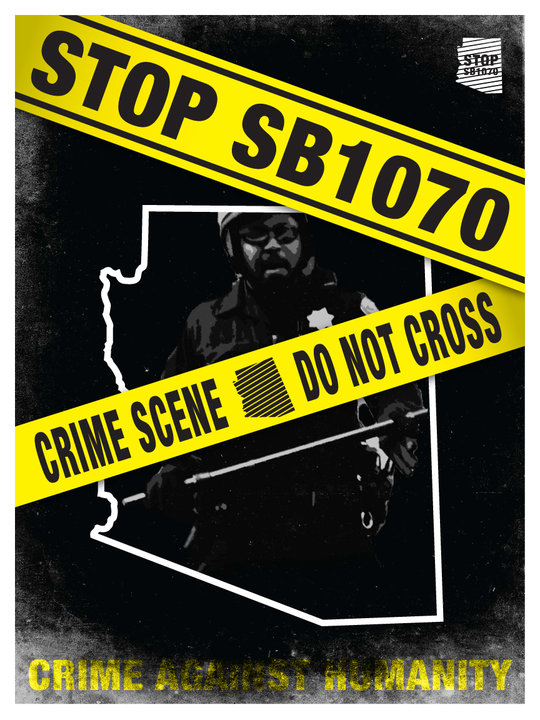
The Big Lie: The Rise of the Extreme Right

By Rodolfo F. Acuña

Arizona Gov. Jan Brewer recently said, “”I believe today…that the majority of the illegal trespassers that are coming into the state of Arizona are under the direction and control of organized drug cartels … There’s strong information to us that they come as illegal people wanting to come to work. Then they are accosted and they become subjects of the drug cartel.” Brewer hedged her statement with phrases such as “I believe” and “There’s strong information.” However, she does not offer an iota of evidence making it the most irresponsible statement that I have heard in my fifty-five years as a political activist.

The fact that Brewer equates an undocumented immigrant to organized criminals and members of the violent drug cartels is disturbing. With this type of misinformation by a public official, it is no wonder that over 70 percent of Americans support the repression of undocumented immigrants believing that laws similar to those of Arizona will keep them safe.

History informs us that the Third Reich came to power as a consequence of half-truths and blatant lies that gradually made most Germans passively receptive to Nazi racial theories. The parallels between Germany in the 1920s and Arizona in 2010 are striking. Then and now intentional lies have that spread fear and hatred of the other.

Who is behind this mass hysteria in Arizona?

A connection exists between white-supremacist and the proponents of SB 1070, targeting of immigrants, and the passing of HB 2281, the assault on ethnic studies. Support has been built for these measures based on big lies and money that have formed the Arizona paranoia—further nurtured by four decades of immigrant bashing. A leading protagonist is Arizona State Senator Russell Pearce, who has taken credit for SB 1070.

In 2004, under Pearce’s stewardship Proposition 200 passed with 56 percent of the vote. The campaign was spearheaded by “Protect Arizona Now” (PAN) and sought to limit undocumented immigrants’ access to public benefits and voting—requiring proof of citizenship when voting and applying for public benefits. Public employees were ordered to deny services to undocumented immigrants and turn them over to authorities. A failure to comply with the law could result in jail terms and fines. The law was challenged in the courts.

Emboldened by its victory over a coalition of prominent Democrats and Republicans, the cabal moved to intimidate legislators. They in taking over the Republican Party. PAN made overtures to extreme right groups, and in 2006 Pearce sent his associates an article on immigration published by the neo-Nazi National Alliance to its base. The article accused “the Jewish controlled media” of creating a bias against whites and favoring minorities and Israelis.

. Meanwhile, the core group strengthened its ties with white-supremacist groups, among which was FAIR (Federation for American Immigration Reform)—founded by John Tanton, a leader in the anti-immigration and “official English” movements. Tanton had close ties with the Pioneer Fund, a proponent of “improving the character of the American people” through selective breeding. PAN received $305,000 from FAIR and the American Immigration Control Foundation (AICF). In turn, the latter groups have received over $1.2 million dollars from the Pioneer Fund. In 2007, the Southern Poverty Law Center labeled FAIR a hate group.

According to Tanton, “To govern is to populate,” prophetically asking, “Will the present majority peaceably hand over its political power to a group that is simply more fertile? As whites see their power and control over their lives declining, will they simply go quietly into the night or will there be an explosion?”

The Arizona groups allies include self described “ethnic separatist” Virginia Abernethy who serves on the advisory board of the Council of Conservative Citizens (CCC), an organization with ties to former Ku Klux Klan Grand Dragon David Duke and white supremacist and anti-Semite writers.

Pearce is also associated with Jason “J.T.” Ready who fronts United for a Sovereign America (USA). Pearce and Ready are allies of Sheriff Joe Arpaio. In turn Ready is a friend of Neo-Nazi Ernst Rohm.

Ready openly invites militias, motorcycle clubs, the National Guard, constitutional groups and the National Socialist Movement (NSM) to his events. The NSM is the largest neo-Nazi hate organization in the United States with 61 chapters in 35 states. Pearce has acknowledged his relationship with Ready.

To round off the equation, FAIR’s attorney Kris Kobach wrote SB 1070. As for Pearce, he openly consorts with neo-Nazis who he has been caught on film embracing.

Where is Brewer in this quagmire? Actually she has gravitated rapidly to the right attempting to fend of the challenge of state treasurer Dean Martin, an Arpaio friend and clone. The signing of 1070 and 2281 paid her dues to the extreme right of the Republican Party that since 2004 has controlled Republican Party primaries.

Similarly Senator John McCain has returned to the fold of the far right. In the early 1980s, McCain served on the board of the US Council for World Freedom, which supported the Contras’ efforts to overthrow the Nicaraguan government. McCain alleges that he resigned from the council which he said in 1986 “got some good people involved.” McCain had opposed Proposition 200 in 2004.

Enter the almost all white Tea Party movement. They have given a shot of adrenaline to the right and ironically respectability to the nativist movement through the creation of mass hysteria. A mob without a center they are easily manipulated by the zealots who have been stoking these fires for four decades. Minute Men, vigilantes, Tea Partiers all stem from the same root.

Yet another player is Tom Horne, the state superintendent for public instruction, who is running for attorney general. Facing the rabid right-wing Andy Thomas in the primary, he decided to Mexican bash and court neo-Nazis which is surprising because Horne is of Jewish ancestry. Horne in order to make himself viable has aligned himself with Ready, Pearce and the cabal of neo-Nazis. In order to attract attention he is given to wild accusations about the highly successful La Raza Studies program at Tucson High School, seeking to abolish it and all ethnic studies programs. Horne advocates censorship of books that he deems as un-American.

Adolph Hitler in Mein Kampf (1925) wrote, “in the big lie there is always a certain force of credibility; because the broad masses of a nation are always more easily corrupted in the deeper strata of their emotional nature than consciously or voluntarily; and thus in the primitive simplicity of their minds they more readily fall victims to the big lie than the small lie, since they themselves often tell small lies in little matters but would be ashamed to resort to large-scale falsehoods.”

While history does not repeat itself, situations and tactics do. Undocumented workers are not drug dealers, criminals or a drag on society. La Raza Studies is not about hate, they are about pride, learning and staying in school. Brewer and Horne know better but it is easier to sell a big lie.

Poster By: Jacqueline Rivera

Honduras, a Year After: The Coup is Not Complete

By JOE SHANSKY

At one point during the military coup in Honduras last year, a US representative to the Organization of American States (OAS) joked that Hondurans were living in a state of “magical realism”, a folkloric literary genre blurring reality and the surreal, often in the historical or political context of Latin America.

He wasn’t far off, despite the bizarre comparison: A democratically-elected president is overthrown by an elite conspiring against him, forced out of the country, the military takes over, the people revolt in massive opposition, while governments across the world refuse to recognize the new regime and withdraw their ambassadors. Only the United States, the most powerful of all countries, remains on the fence, then hops off onto the side of the golpistas (coup-makers) while presenting a straight face of diplomacy.

Yes, the story of how elected president Manuel Zelaya was violently removed from power under the guise of legal proceedings would make great fiction, but sadly remains the true story of the first successful Latin American military coup in decades.

Honduras burst into the international news last summer when on the morning of June 28th, Hondurans awoke to a dismantled government and a military takeover of their country. The Honduran Congress had just issued the trumped-up charge that Zelaya, of the Liberal Party, had violated the law by attempting to assess the interest of the general population in potentially rewriting the outdated Constitution to include progressive reforms. Hondurans were scheduled to vote that day in a non-binding referendum.

Instead, the president was flown out of the country by military troops operating under the orders of Congressional head Roberto Micheletti (of the same party), who then became de facto president. The people took to the streets in protest. The police and military, acting under Micheletti’s command, responded with violence, and a saga began which continues to this day, despite a new administration.

It quickly became apparent that many of the leaders of the military establishment which seized Zelaya and spent the past year ensuring that Hondurans lived in perpetual fear, had in fact been trained at the infamous School of the Americas, one thread of many leading back north.

Enter the United States, whose intervention in the region is unfortunately not limited to the history books. From the beginning of the coup to the most recent headlines on Honduras, the shadow of the U.S. has loomed large. The US mainstream media are eager to discount Latin American social movements demanding autonomy, as motivated by the presumably sinister leftist influence of Hugo Chavez and other leaders in the region. Zelaya came into power by no means a radical, but he gradually worked to enact common-sense progressive measures. Some examples: a higher minimum wage, agrarian reform, an idea to convert the US military base in Soto Cano to a civilian airport, a rejection of recent IMF agreements, etc. These changes were seen as a threat by a ruling oligarchy both in Honduras and elsewhere, which viewed their business and economic interests as in jeopardy.

When Zelaya was forced out, Barack Obama wrist-slapped the golpistas, but refrained from using the legal language necessary to trigger more drastic measures against the coup government, such as economic sanctions, freezing assets, or withdrawing his ambassador, as so many other countries did immediately.

The most significant result of all of this is the popular uprising which has been under the threat – and reality – of violence since its inception. June 28, 2009 marked the birth of a grassroots movement formed out of the simple premise that the electoral process which brought Zelaya into power by popular support must be respected and defended to its legal end.

Day after day last summer, around the country in both rural and urban zones, Hondurans marched to demand Zelaya’s return and the re-establishment of democratic order. As I participated with the marchers, it was a glorious domino effect to witness – families walking proudly down the road, beckoning others peering cautiously out doors and windows to join the crowds, whose numbers grew exponentially each day.

Meanwhile, the theatre continued and the performances, especially by the U.S. State Department and the U.S. Embassy, in particular Ambassador Hugo Llorens, were impeccable.

I had the opportunity to meet with the Ambassador in August 2009, as part of a delegation monitoring human rights. He was sympathetic (“You’re preaching to the converted” and “We condemn the regime, and think that they’re thugs”), but despite several references to the urgency of the situation, he turned out to be a master at extending the “diplomatic process” until it was too late for many. The amount of recorded evidence of illegal abuses directly connected to the Micheletti and Lobo governments is overwhelming. So is the number of hours of tape which has State Department representatives finding new ways to avoid addressing this topic when pressed.

In general, the US continued to disregard the increasingly threatening measures taking place – activists, media, and government figures opposed to the coup were targeted, resulting in account after account of kidnapping, torture, and murder. A February report by the Committee for the Families of the Disappeared and Detained in Honduras (COFADEH) lists 40 confirmed Resistance-related deaths, though that number continues to grow since then. In addition, there was an almost-total blackout of the independent media outlets which much of the country relied on to get their news. All of this went on as backdrop to the run-up of new elections. The US eventually brokered an agreement leading to the installation of the Lobo government, by means of approving an election cycle in a climate of fear and intimidation, where press freedom was severely restricted.

As more people went missing, were detained at random, were found in ditches with signs of torture, as horror stories emerged daily, certain individuals and organizations on the front lines became more vulnerable.

In hindsight we can see now just how risky it was – and still is – to be in visible opposition to the golpistas. During the days of street repression, the state violence was uncontrolled, unleashed against groups that always appeared physically united in the streets.

Now, in contrast, the Resistance movement, led by the National Popular Resistance Front (FNRP), simply referred to as the Resistance, has become more physically fragmented, and thus more vulnerable. Now the disappearances and killings are targeted. Those who put their life on the line last year continue to pay the price. Family members of activists are at risk as well. The most brazen acts are still being seen today. All we need to do is look at those who have suffered the most for being at the front lines.

Out of all sectors of the Honduran population, the gay and lesbian community has seen the highest number of victims. Usually they have been connected directly to opposition circles, and the majority of incidents have happened since Pepe Lobo took office in January. The most notorious case remains that of Walter Trochez, a beloved organizer who was captured, escaped, and then killed a week later.

Journalists – Nine have been killed in the country so far this year alone, with the great majority working for news outlets opposed to the coup. The Committee to Protect Journalists has listed Honduras as one of the most dangerous countries in the world in regard to their mission.

Unions – Throughout the coup, the offices of the Honduran Union of Industry Workers of Soft Drinks and Similar Beverages (STIBYS) became shelter for the Resistance and their allies. The union was targeted by armed forces during the coup, and its leaders have been subject to constant assault and persecution. STIBYS president (and former Honduran presidential candidate) Carlos H. Reyes was badly beaten during a protest last year. Earlier this month, the brother-in-law of STIBYS Vice President Porfirio Ponce was killed in an attack when armed men stopped his car at a traffic light, also wounding Ponce’s father and sister.

Farm workers – Outside the cities, agricultural and rural organizations have been under threat as well. There is an almost constant military presence in rural areas where farmers and peasants are fighting for land reform. In the Aguán region, where Zelaya’s efforts to redistribute land were most at stake, tensions have exploded into what has been described as “clashes”, but is in essence a war against the campesinos, in particular the United Campesino Movement of Aguán (MUCA). Eight campesinos have been killed since December 2009, when workers moved to retake the land they had been stripped of in the chaos of the coup.

While writing this, I receive notice of another campesino killing, a 16 year old boy. Gruesome photos showing his torture are attached. Five others have been arrested. These incidents have become common.

What allows us to receive this news only a few hours after the fact is a dedicated network of support in both the US and around the world. Despite the constant familiar dread of opening bad news emails, it’s been a pleasure to witness such solidarity. Previously isolated organizations, many of whom sent delegations to Honduras or were actively monitoring the coup, have united into what is now formally known as the Honduran Solidarity Network.

The HSN has evolved to a level of professionalism and consistency that would be difficult to maintain for many, involving participants spread over various countries. Member groups hold conference calls weekly, with updates coming directly from FNRP connections. Twice they have pooled funds to publish full-page ads in major Honduran newspapers declaring international support for the Resistance and opposition to the Lobo government.

These actions are increasingly important as the violence in Honduras continues to remain under the radar.

All causes and effects of the coup are still alive, but President Lobo is now going through the motions to set up a Truth and Reconciliation Commission with a mission statement that couldn’t be more vague (“to ensure peace, harmony and tranquility for the Honduran people”), and which has no teeth. It is not legally binding and it does not take into consideration accounts by any of the human rights organizations that would clearly offer the most critical perspectives when it comes to investigating these crimes.

In response, six key human rights organizations have come together to create an alternative commission, to be launched on the first anniversary of the coup, and headed by respected figures such as Nobel laureates, writers, and priests. Among other mandates, the “Comisión de la Verdad” will make a point to hear the testimonies of victims, and be in will line with United Nation standards.

Details on both Commissions, including backgrounds of members, can be found here.

To this day, no U.S. State Dept. spokesperson has acknowledged the thousands of human rights violations committed under the Micheletti and Lobo governments. The US continues to maintain the absurd claim that reconciliation has come to the country, recently seen in Hillary Clinton’s efforts to persuade the OAS to re-admit Honduras. And on June 18, Llorens announced that the Honduran government would be receiving $20 million from the US to enhance “security”.

Not all US politicians have responded this way. Some have been strong allies of the opposition movement. A new letter signed by 27 US Representatives, addressed to Clinton, makes for the strongest wording yet, written to “…express our continuing concern regarding the grievous violations of human rights and the democratic order which commenced with the coup and continue to this day.”

A year old now, the Resistance has grown into a widespread political body. As Los Necios put it, it “has shifted from short-term action to the structures and strategy to take power and change the country”. They imagine a different Honduran society, with an eye to the project Zelaya had begun to take initial measures on- the reformation of the Honduran Constitution, or constituyente.

Zelaya himself, still in exile, recently affirmed his commitment to the project in a letter dated June 11:

“I am a liberal in permanent resistance and I will continue being so, of those that practice their true doctrine, opposed to military dictators and antidemocratic regimes…The homeland in this moment calls us to struggle for unity and for the Constituyente…the suffering of the victims of this crime against humanity, with the loss of lives of our martyrs who condemned the coup d’Etat, cannot be in vain, nor pass into oblivion.“

What happened in Honduras is worth revisiting a year later, if only to understand that despite all rhetoric by both the US and Honduran governments, the coup is not over. June 28 marks the anniversary of the tragedy it brought.

But this date should also be celebrated as the birth of a movement that has united diverse forces from around the country. It offers hope and inspiration for a new Honduras in which the people have a voice over their own destinies- some would say a magical story, becoming more real each day, still being written.

Joseph Shansky reported from Honduras during the recent military coup, and can be reached at fallow3(at)gmail.com This piece also appears in Upside Down World.

Source: CounterPunch