RPMA Update

“Only a working class/liberation-based media can help bring about change in society”

• The RPMA (Raza Press and Media Association) will hold its next “General Meeting”, on August 28, 2010 (9 AM to 12 Noon), in Los Angeles, Calfaztlán. The date, time, and location (TBA) will enable people to attend the RPMA general meeting and participate in the 40th Commemoration March of the Aug 29th Chicano Moratorium of 1970.

• On our web page you will find “on the ground” covering of the U.S. Social Forum (USSF) that took place in Detroit. A team of RPMA members wrote articles, created pod casts, and videos of some of the activities that took place at the USSF.

• The Summer Issue Guerillera/os de La Pluma, edited by Jose Moreno, is now posted. It has excellent informative articles. This issue addresses the question of terrorism and current situation in Arizona, where colonialism has exposed itself as being “alive and well”. You will find articles on Raza Studies, Colonialism, and the role of the Liberation media vs. media of the capitalist-colonialist oppressor.

• Also, check the “Books for sale section”. There are limited copies available of books that should be of concerned to those active in the field of Raza journalism or those interested in the political struggles of La Raza (Chicano Studies students, social justice activists, revolutionaries, etc.).

The sad reality is that our community does not have an effective media that represents its interests and aspirations. The great majority of today’s “Raza media outlets” are assimilationist or reformism, or “individuals doing their own thing”. It aims to “work within the system” or “improve it”, or fight back without “organization or unity”. History has taught us that this approach doesn’t work and never will. Capitalism is a racist/colonial-fascist and rotten system that will never benefit Raza or the working class communities of the world (the great majority of humanity).

The RPMA takes the position that to end poverty and racism we need revolutionary change. And, that only a working class/liberation-based media can help bring about change in society.

We are calling all Raza media workers to unite with us to share skills, resources, and network into a powerful weapon in our struggle against colonial-fascism, capitalism, and racism, wherever it exist on planet earth.

ATTEND THE RPMA GENERAL MEETING ON AUGUST 28TH!!!

Arizona: The Death of the Fourth Estate

By Rodolfo F. Acuña

The press in theory is supposed to safeguard democratic principles. During a parliamentary debate in 1787, Edmund Burke supposedly referred to the press corps reporting the activities of the House of Commons as the Fourth Estate. Hypothetically the press was the champion of the public.

According to its supporters, the Fourth Estate acted as a mediator between the public and the elite. Journalists listened to and recorded the activities of those with power. An enthusiastic John Dewey believed that the public was capable of understanding and discussing policies and should be part of the public vetting process. Thus, the press would provide a forum where the people could weigh the consequences of policies being considered by those who governed.

Hence, the journalist’s foremost duty was to tell the truth. But, over the years there has been an erosion of the public trust in the Fourth Estate, as the media has been monopolized by those President Franklin Roosevelt in 1936 called economic royalists that control the country.

President Roosevelt summed up this process of the monopolization of society saying, “New kingdoms were built upon concentration of control over material things. Through new uses of corporations, banks and securities, new machinery of industry and agriculture, of labor and capital – all undreamed of by the Fathers – the whole structure of modern life was impressed into this royal service.”

The Arizona media is the worst example of an institution abandoning its mission to educate the public. On the current immigration crisis, the media’s coverage of SB 1070 has been spotty both inside and outside the state. Regarding HB 2281 that outlaws ethnic studies, the media has been mute with the news either distorted or not reported.

I learned recently from two reporters that new editors around the state had directed their staffs not to cover opposition to the laws. For example, coverage of civil disobedience by students has gone unreported.

In order to shine a bright light on what is happening I contacted several Chicano journalists. A respected journalism professor wrote of Arizona: “As you well document and others have also, in recent years Latinos have been unfairly targeted, scapegoated and vilified by much of the general audience media, not just the usual right wing targets. This isn’t the first time, as we both know from our long work in this area. But at a time when the ‘mainstream’ media are steadily losing audiences, they seem to think they can build a more credible news report by either ignoring or misrepresenting the largest and fastest growing segment of the population….”

The problem in Arizona and indeed in most of the country is nothing new—it is systemic. As the traffic of undocumented Mexicans and others increased through southern Arizona in the 1980s and 1990s due to federal policy changes, the issue of immigration was politicized. Border Patrol sweeps in El Paso and San Diego channeled the traffic of undocumented Mexicans through southern Arizona, forcing many to brave the hazardous desert of southern Arizona. In this atmosphere many of the ranchers took the law into their own hands, hunting down Mexicans, entreating others to join them in the hunt.

Beside herself, Professor Guadalupe Castillo of Pima College in 1980 asked a New York Times reporter, why the national media was so silent, he responded, “The border is a Third World country, and people just don’t give a damn.”

The silence of the press encouraged Patrick Hanigan, his brother, Thomas, and their father, George, in August of 1976 to round up three undocumented workers, who crossed their ranch, which fronted the Mexican border west of Douglas, Ariz. The Hanigans tortured them, using hot pokers, cigarettes, and knives and fired a shotgun filled with bird shot at them. The ordeal lasted several hours before the Hanigans sent the three workers naked and bleeding back across the border.

An all white jury acquitted Patrick and Thomas Hanigan in 1977 of fourteen counts of assault, kidnapping, and other felonies. Their father died before the trial. A public outcry led by Chicano organizations forced the Jimmy Carter administration in 1981 to try the Hanigans on civil rights violations. A federal jury found Patrick guilty. Thomas, because of his young age, was acquitted. At least fifteen killings and more than 150 incidents of alleged brutality occurred against Mexicans in Arizona alone during the 70s.

In 1981 another all-white jury in Arizona state court found a former rancher, W.M. Burris Jr., 28, guilty of the unlawful imprisonment and aggravated assault of a Mexican farm worker. Burris suspected his employee of stealing, so he chained the worker around the neck. The jury, however, found him not guilty of the more serious charge of unlawful imprisonment and kidnapping.

The most obnoxious wanna-be ranger was Roger Barnett, who boasted that he made thousands of arrests of Mexican migrants on “his ranch.” Barnett and his followers sent out a racist flyer inviting white supremacist groups to come help them “hunt” Mexican “aliens.”

During these three decades, a reasonable person would have expected the Arizona media to inform Arizonans about civil behavior. Instead they have been intimidated by those who shout the loudest. They have betrayed their public trust and not had the courage of their convicts.

Edward R. Murrow must be turning over in his grave. The media has abrogated any duty to objectively inform the public. For instance, Arizona just passed a law allowing almost any adult to carry a concealed or unconcealed weapon for any reason — with or without a permit. The media has refused to take a position.

However, I wonder what the position of the media would be if Mexicans, Latinos and African Americans started showing up at rallies with guns strapped to their waists?

Occasionally the media gets it right. Recently, New York City Mayor *Michael Bloomberg** *and News Corp. CEO *Rupert Murdoch advocated* the securing of the border, but also called for providing a path to legal status for all undocumented immigrants. Neither is a liberal but they recognized good economic policy. The news conference was mentioned by the press and then dropped; the electronic medic was even less probative.

Clearly the Fourth Estate is no longer a factor in American life. It does not want to offend the Burrises and Barnetts of Arizona. Hence, as Roosevelt foresaw “the whole structure of modern life was impressed into this royal service” with the media serving clients and investors.

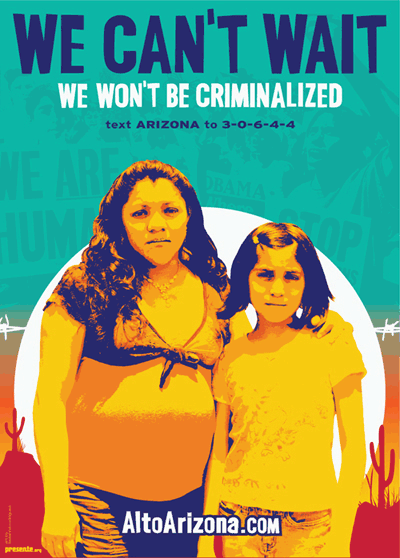
Poster By: Favianna Rodriguez

Todos Somos Los Medios!: Voices from the US Social Forum 2010

By Francisco Romero, RPMA Media Team

“We understand clearly that we (as activists, artists, community organizers, media makers) are the change agents we have been waiting for.” (USSF 2010)

(Detroit, MI) For this year’s U.S. Social Forum, the Raza Press and Media Association (RPMA) , along with our allies at the Xicano Development Center’s (XDC) program Radio Free Aztlan , embarked on a tireless five day joint collaborative media project. With over 15,000 in attendance and 1,086 workshops, the U.S. Social Forum served as an organizing space for sharing of ideas, strategies, tactics and overall plans of action to build and enhance the grassroots social movements confronting “deeper and more pervasive poverty world-wide, unsustainable industrial and developmental practices that accelerate global warming, massive displacement of communities due to trade and economic development, and and rampant speculation in speculation in financial markets” that have led the the economic crisis that exist today.

With so many participants, it could be very easy for a voice to be lost in the abyss of the global intertwined network of resistance. So, to that end, the RPMA and the XDC prepared and coordinated an organized effort to document and share the unique lessons voiced by those in rebellion, in resistance, in struggle, be it the fight against wars of aggression and militarization, the struggle for self-determination and liberation, the on-going battle for “work, land, housing, food, health care, education, independence, freedom, democracy, justice and peace.”

THE PEOPLE’S MEDIA CENTER
Hundreds of media workers gathered and set up working stations at the People’s Media Center (PMC) on the second floor of the COBO Exhibition Hall and Conference Center, the central U.S. Social Forum 2010 meeting space. The USSF 2010 stated. “The People’s Media Center (PMC) at this year’s US Social Forum in Detroit seeks to keep up with this evolving media landscape and once again break new ground in changing the relationships between media, cultural workers and the movements they cover. The People’s Media Center will serve not only as a hub for traditional, new and people’s journalists in this new media world to connect and share, but also a space for many story-telling, cultural and artistic activities to take place continuously and throughout the forum.” The Raza Press and Media Association, shared a working space alongside, TeleSur, Democracy Now, Real News Network, IndyMedia, Free Speech TV, among dozens of others.

The role of grassroots, independent media was extremely important at this year’s USSF 2010, having that the mass corporate media seen the forum as “disregarded marginal and irrelevant — that is, if they’re regarded at all?” (AlterNet) Where else was there such a mass convergence taking place? The FIFA World Cup 2010 spectacle overshadowed the U.S. Social Forum and the protests of the G-20 in Canada.

In short, if it were not for the humble efforts of a handful of committed media activist/organizers, the U.S. Social Forum 2010 could have easily been forgotten. The reality is that we exist and resist, with innovative “Up-to-the-minute radio, print and video reports produced through the center and broadcasting on partnering networks; fed to local and national media outlets; and published on social networks, blogs, websites and portals all across the US and the world. With daily press briefings and a diverse speakers’ bureau, the center will also seek to connect grassroots organizers and leaders with mainstream journalists to generate widespread coverage of the ideas, events and people of the USSF.” (http://www.ussf2010.org/pmc)

THE DETROIT PAPERS
It was nearly seven years ago on September 20, 2003, where a handful of media activists convened at the RPMA’s Summit entitled, “Develop the Means to Wake Up the Masses-Become Part of History-Help Build an Independent Raza Media Association”, in the small community just outside of Detroit, in the town of Ypsilanti, MI, at Eastern Michigan University. At this summit, participants discussed, debated and adopted a resolution of four sections that would lead the then Raza Press Association (now Raza Press and Media Association) into the next period of struggle on the media front.

Section 1 of the Detroit Papers was entitled, “A: Only Responsibility and Accountability Will Enable Us To Build and Consolidate the RPA.” The next section was entitled, “B: Only Active, Systematic, Tactical and Consistent Dissemination of Progressive News and Information In the Community Will Allow Us to Wake Up the Masses.” The third section was entitled, “C: Building a Raza Press and Media to Defend the Rights and Interests of Our People.” The final section was entitled, “D: Journalism Is Inseperable from the Liberation Struggle.”

It is important to highlight, that the major sections, goals and objectives of the Detroit Papers have been worked on consistently for the past seven years. Countless organizing meetings, dozens and dozens of writings, events, forums and book fests, as well as the on-going developing of technical skills (audio, video, print, etc.) have been expanded.

For the first time, in one concentrated event, the RPMA had a “Media Team”, with about six media workers, utilizing sound recording, video, and photography to document and immediately report about the interviews, forums, actions and workshops. At the the U.S. Social Forum’s People’s Media Center, RPMA media activists sat, edited, wrote, and produced articles, audio and video podcasts at the about the nearly 50 interviews that were conducted throughout the week.

TODOS SOMOS LOS MEDIOS (WE ARE THE MEDIA)

As media activists, as organizers, and ultimately as Mexicano Indigenous freedom fighters, we will have to take a stand on the side of our people. This means, that we must learn the skills necessary to create media, in the form of writings, videos, audio recordings and beyond, including cultural and artistic forms of expression (paintings, creative writings, music, etc.). If we fail to write our own history, than we will have to read about our advancements and defeats from the perspective of the oppressor.

With the technological tools at our disposal, such as computers, printers, copy machines, access to the Internet and the various social web-based networking platforms (FaceBook, ListServes, etc.), there really is no excuse whatsoever to not have a weekly, if not daily, news reporting effort coming from the Chicano/ Mexicano working class perspective. There is no excuse whatsoever for not having a short written summary, a blog, a poem, an article, a song, or an audio or video piece that immediately brings attention to, analyzes or current conditions, and offers an alternative reporting to that of the corporate media.

We need a People’s Media, one that is willing and able to combat the onslaught of commercial and profit-driven news and information being spewed on a daily basis. We need a People’s Media that can and will expose the brutal realities of the capitalist economic crisis and its impact on workers, on education, on healthcare, and on society as a whole. We need a People’s Media that will report about the “deep pervasive poverty world-wide, unsustainable industrial and development practices that accelerate global warming, massive displacement of communities due to trade and economic competition, and rampant speculation in the financial markets” and other pressing issues that impact us today.

So, the time is now, to be part of the solution. Pick up your pen, brush, or camera, and join our struggle to build a People’s Media to Defend the Rights and Interests of the Working Class. Join the Raza Press and Media Association!

Por una Prensa Libre y Popular en Defensa del Pueblo!

Creative Commons License
This work is licensed under a Creative Commons Attribution-NonCommercial 3.0 Unported License.