By GEORGE CICCARIELLO-MAHER
Oakland.
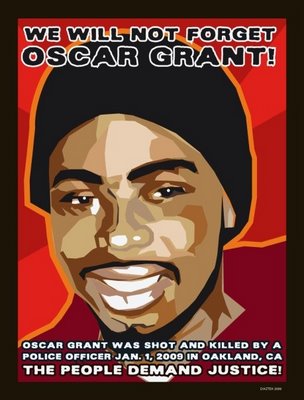
For the fourth time in less than two years, Oakland has become a surreal scene. As though fleeing a tsunami, thousands have packed into their cars in a mass exodus from the downtown area, and are sitting in twenty blocks of traffic headed north on Broadway. The jury in the murder trial of Johannes Mehserle, the transit cop who shot and killed Oscar Grant some eighteen months ago, has reached a verdict, which will be read in a few short minutes.
The response by the Oakland Police Department and the thousands of other officers drafted into an ironically-titled “mutual aid” scheme has been predictably overblown: alarms have been triggered in major buildings downtown to force evacuations, and the fear of God has been struck into the heart of every corporate and government employee in a ten-block radius. The police, it seems, are expecting a war, and are preparing accordingly.
Nonprofits: Velvet Glove of the State
But as I have said previously, this was never just about the police, as a powerful alliance had emerged between nonprofit and local city leaders whose sole objective seemed to be heading off a repeat of last year’s rebellions by co-opting the anger of the people at the verdict. Instead of a well-orchestrated symphony of hegemonic control, however, this alliance yielded a cacophony of clumsy embarrassment that discredited all involved. Here is how it played out:
Absent for the preceding 18 months while community members busily demanded and worked for justice, a whole host of state, business, and nonprofit institutions jerked into motion in the face of the impending verdict. Their clumsiness was immediately transparent in a staged press conference thrown together at the last minute by Mayor Ron Dellums with the participation of city leaders and the Oakland Police. In desperate need of some degree of legitimacy, the Mayor’s office drafted three members of the Laney College Black Student Union, who were trotted out and expected to parrot the official line: Peace without Justice.
While the measure was partially successful in providing the barest façade of unity (for example, in the uncritical coverage by the Oakland Tribune), the reality was that this co-optation attempt was a partial victory at best: the three young men took turns attacking the police for their threatening preparations and distinguishing between property destruction and violence, while Dellums squirmed and OPD chief Anthony Batts stared on in icy silence. Afterward, all three young men angrily confessed to feeling “used” by the Mayor and city officials.
Simultaneously, a whole host of nonprofits with nominally radical roots drew increasingly closer to the city and pushed the same line. The Urban Peace Movement, for example, teamed up with Youth Uprising to push the slogan “Violence is Not Justice” a now-notorious Public Service Announcement which was as ill-conceived as the Mayor’s press conference. In the PSA, the violent murder of Oscar Grant is explicitly equated to the property destruction that followed, and the nonprofit-state alliance becomes absolutely clear in interviews with OPD as well as San Francisco District Attorney Kamala Harris. Once released, the PSA was explosively polarizing, even within the nonprofit community, where many well-meaning activists take economic refuge.
Similarly polarizing was the next effort by the nonprofits and local government, one aimed more directly at the community-planned day-of-verdict event. A local, democratic, grassroots organization known as the Oakland Assembly had planned for months a gathering on the day of the verdict, one which would privilege the voices of the young people of color most affected by police violence, but this did not stop nonprofits and local city officials from attempting to upstage the community by holding their own event less than a block away, in front of City Hall, and demanding that community organizers join the official event.
Community organizers quickly denounced this and other efforts by nonprofits and city officials to co-opt the popular movement for justice in a press conference that was largely ignored by a media looking for sensationalistic stories of impending violence. Community calls for freedom of speech and assembly to be respected were taken up by some in the nonprofit community who did not buy into the city’s intimidation campaign and attempt to police movements, and once it became clear that the Oakland Assembly would not participate, the city-sponsored event collapsed.
“My Son Was Murdered!”
As the slow stampede of commuters continues to pour out of Oakland, we receive word of a verdict: involuntary manslaughter, which some had been predicting from day one. While it was initially unclear, the jury did in fact add a weapons enhancement, but it remains to be seen whether or not Judge Robert Perry will allow the seemingly contradictory conclusion–an involuntary killing alongside the purportedly voluntary use of a firearm–to stand. As though expecting that his final sentencing would prove controversial, Perry scheduled it for a full month later, on August 6th, but to add insult to injury, a defense motion was granted which postpones sentencing indefinitely.
In a clearly emotional response to the media after the verdict, Oscar Grant’s mother Wanda Johnson responded to the verdict in the most unambiguous of terms:
My son was murdered!
He was murdered!
He was murdered!
He was murdered!
My son was murdered!
And the law has not held the officer accountable…
Grant’s uncle Cephus “Bobby” Johnson expressed a sentiment similar to Wanda’s, that the family had been “slapped in the face by this system that has denied us true justice.”
In a nauseating parallel to the Youth Uprising PSA, the Director of that same organization, Olis Simmons, took Bobby’s statement as an opportunity to turn the violence of the state once again back toward its victims. Knowing perfectly what she was playing into, she told that mouthpiece of reaction in the Bay, the San Francisco Chronicle, of her disappointment at Bobby’s words: “Damn… He just opened the door. Kicked it open. I don’t think he meant to, but he did it.” Thus from mourning uncle, Oscar Grant’s uncle Bobby is symbolically transformed into violent aggressor. This tactic, so long used by abusers of all stripes, is called blaming the victim, and it is reprehensible.
The Verdict of the Streets
While the community organizers of the Oakland Assembly had not planned to begin their event until 6pm, patience was not in the cards after the verdict was read, and by 5pm more than 200 had gathered on the steps near 14th and Broadway to express their disappointment and even disgust with the verdict. When Assembly members finally occupied the intersection, the crowd soon joined, chanting and blocking traffic.
As speakers began to reflect on the verdict from a makeshift wooden platform in the middle of the intersection, a bus attempted to pass but was promptly blocked by the crowd. There was some disagreement, with some asking that the bus be allowed to pass, but others refusing to let it budge, insisting on stopping “business as usual.” It was then, before the community speak-out was even scheduled to begin, that police provocations began in earnest, with a squad car charging in with sirens blaring and lights flashing to free the bus.
This proved unwise. Within moments the crowd beat back the police, who were seen scurrying back down Broadway toward 12th. This would have been an unambiguously beautiful sight were it not for the fact that the fleeing police, protectors and servants of the people, backed their cruiser over a deaf woman who was protesting in the intersection. The crowd was now divided in two, with enraged onlookers confronting the police on 12th while young people continued to speak out from the platform on 14th.
Tension simmered in the air, and a young Black woman seized a megaphone with a simple message that turned the mantra of the city and the nonprofits, “Violence is not Justice,” squarely on its head:
“We want justice! We want a riot!”
While this certainly expressed the sentiments of some, the Oakland Assembly event continued peacefully until its designated end time of 8pm, by which point police encirclement was complete. It wasn’t long before the growing crowd, now nearly 2,000 strong, like a young bird in a nest, grew restless of its constraints. Against the insistence of some that those gathered move toward the safety of Frank Ogawa Plaza, the opposite happened: first a trickle and then a stream of angry demonstrators moved down Broadway toward the creeping police lines at 12th.
Festival of the Oppressed
First water bottles were tossed toward police lines, with police responding with an unwarranted degree of panic. A Subway window is smashed. The crowd begins to swell in the opposite direction, up to and beyond 14th. When one voice on a megaphone drifted through the crowd voicing the traditional mantra, “No Justice, No Peace,” this was met immediately with some skepticism, as one in the crowd replied: “Don’t say that shit unless you mean it.”
More interest is attracted by a boom box blasting NWA’s “Fuck the Police,” as young people dance ecstatically in a circle. The song’s chorus becomes a chant, a booming echo between tall buildings, and is soon directed from a distance at police lines holding back beyond 15th. Attention soon turns to a Foot Locker: the glass is broken, the metal gates literally torn apart with bare hands, as the store’s content, normally unattainable for some, beckoned. Within mere minutes, and with police looking on, the store’s displays and even stock room are emptied of all contents, some carried off, some tossed into the watching crowd. “I’m size 12!” one onlooker shouts.
Some have already blamed the property destruction that occurred on “outside agitators” and white anarchists. While some anarchists were certainly present, some of whom were indeed white, and while they may have played a role in, for example, the broken windows at a bank across the street, and the broken Rite Aid window emblazoned with the ironic graffiti, “Involuntary Property Destruction,” to blame anarchists for the palpable anger in the streets that night is utterly comical (especially given the existing video footage).
But while many took the opportunity to grab shoes, jerseys, and baseball caps, the commodity-form did not escape entirely unscathed. Just as Marx famously remarked that the commodity simultaneously embodies use-value and exchange-value, the objects expropriated from Foot Locker were treated with a combination of celebration and hatred in accord with this twofold character. Those items not taken home to fulfill human needs (or re-sold to do so) were summarily burned in the street, in a most elemental attack on the “fetishism of the commodity” which proves in practice that what is made by human hands can also be thus destroyed and returned to dust.
If anything, this brief moment was notable for a total absence of any conflict within the crowd, as white and Black, anarchist or otherwise, came together however fleetingly as comrades. But fleeting it was, as the police were all the while biding their time and waiting to move in. And it was not agitators, but infiltrators, who posed the most danger, as many observed undercover police dressed not as black-clad anarchists, but as media, equipped with press passes issued by the City of Oakland. The police would soon sweep in, arresting nearly 80 and slapping many with the sorts of trumped-up arson charges we saw pressed only to be eventually dropped last year.
Desley, Desley, Desley
But this tale of co-optation and state violence would be far from complete without introducing, or rather re-introducing, one more character: Desley Brooks, city councilwoman representing East Oakland. While Brooks may seem to act the part of your ordinary elected official when the cameras are rolling, she becomes a veritable Mafioso behind the scenes.
During the Rebellions of January 2009, Brooks was spotted moving between march organizers and police, although we can’t be sure what sort of information was being relayed. When the Oakland Assembly planned a vigil and community memorial for Oscar Grant on the January 1st anniversary of his murder, and without consulting the Assembly, Brooks assembled a stage and sound system for the event. When it came time for Assembly members to put forth a more radical agenda than she could stomach, Brooks sent a clear message: “This is my stage–get the fuck off.”
It is this sort of open sabotage of the community that has led many to be wary of Desley Brooks and her often dubious tactics. In fact, the event planned at City Hall for the day of the verdict was in fact Brooks up to her old tricks, as an email reveals, and as tensions in the crowd arose that day, Brooks consistently placed herself between police and demonstrators, doing so not to protect the people but to keep them in line.
As the day wound down and police began to sweep across the intersection to brutalize and arrest, I stood with a young, multiethnic group of demonstrators enraged by the verdict. One young Black man, Jevon Cochran, more out of desperation than aggression, symbolically tossed a cardboard box in the direction of the police, but it was not the police who responded. Rather, it was Desley Brooks and her orange-vested goons that rushed us, grabbing and punching us. These “volunteer peacekeepers” as they were calling themselves that night, are in reality employed by the office of Mayor Dellums himself, but what they didn’t realize was that Cochran was one of the three young men that Dellums himself had trotted out in a desperate bid for legitimacy.
Desley, clearly infuriated, began to attack us verbally as her “peacekeepers” attacked physically. Recognizing me from previous demonstrations, she seethed, “I’ve seen your bitch ass at all these things.” Yes, I remind her, I had confronted her for talking to the police on January 30th 2009, and for sabotaging the community event on January 1st 2010. As though taking the police soundbyte as reality, one of her thugs pointed to the small crowd, declaring “You don’t even live in Oakland!” Those assembled began to respond spontaneously: yes, in fact, most live in Oakland. Those nearby did not hesitate to cast judgment, pointing at the orange-vested servants of the state and chanting: “Pigs go home! Pigs go home!”
We move away from the clear provocation as Desley and her thugs try to wrap their condescending heads around the unthinkable: a young, Black man who shares none of their conciliatory views toward the state. Eventually, the desperate conclusion is reached: “he can’t think straight because he’s not surrounded by his own.” If we didn’t know it already, the Oscar Grant rebellions have taught us clearly that when reformist sell-outs and collaborators in communities of color are challenged, vulgar nationalism (as opposed to its revolutionary variant) becomes an all-too-easy refuge.
As POCC Minister of Information JR puts it in a recent article on Desley Brooks:
Where does she stand? When are we, as residents of Oakland, going to challenge this government hijacker and people like her? … We should judge a tree by the fruit it produces, and not by anything else… I think she should push the bar, and call for more indictments, instead of trying to throw rallies… If she refuses to do that, we should look at her funny when she slithers back around during re-election time. We, the residents of Oakland, need to play hard-ball with her and all other government and non-profit personnel that are faking the funk.
Identifying Enemies, Making a Scene
Was this a battle lost to win the war? A battle won at the expense of the war? Has the cycle of struggle initiated by Oscar Grant’s murder wound down to its inevitable close? Unfortunately, or perhaps fortunately, things aren’t so clear.
After a particularly explosive response to racism, Black revolutionary Frantz Fanon once summarized his dual accomplishments as follows: “I identified my enemies and I made a scene.” If that is all we have done in the past year, this is no small accomplishment, since as Fanon teaches, to clearly identify our enemies is a precondition to victory, and it is often in making a righteous scene that our enemies identify themselves and that we steel our resolve to eventually defeat them. Is Desley Brooks an enemy of the people? Olis Simmons? Fortunately for them, the people are patient, but this patience is not unlimited.
As we weave through Old Oakland amid the distant flash and thunder of concussion grenades, an informal discussion of looting develops. Cochran, who has in the past week found himself both manipulated by Ron Dellums and assaulted by Desley Brooks, puts it in the following terms:
Corporate spots like Foot Locker are tied directly to exploitation and oppression of Black and Brown people, and they’re underpaying and exploiting the people making these shoes, so if people are gonna steal shoes and smash windows at Foot Locker I’m not gonna stop them. They’re just taking shit for the same price Foot Locker pays the workers! And there’s nothing wrong with people taking shit they can’t afford. I’m glad they got those sneakers… and those caps.
George Ciccariello-Maher received his Ph.D in political theory from the University of California, Berkeley. Yes, he lives in Oakland, and can be reached at gjcm(at)berkeley.edu.
Source: counterpunch.org
