Open Veins of Latin America: Five Centuries of the Pillage of a Continent [Book Note]

By Eduardo Galeano

“This book is a monument in our Latin American history. It allows us to learn history, and we have to build on this history.”
— Hugo Chávez, as reported by the BBC

Since its U.S. debut a quarter-century ago, this brilliant text has set a new standard for historical scholarship of Latin America. It is also an outstanding political economy, a social and cultural narrative of the highest quality, and perhaps the finest description of primitive capital accumulation since Marx.

Rather than chronology, geography, or political successions, Eduardo Galeano has organized the various facets of Latin American history according to the patterns of five centuries of exploitation. Thus he is concerned with gold and silver, cacao and cotton, rubber and coffee, fruit, hides and wool, petroleum, iron, nickel, manganese, copper, aluminum ore, nitrates, and tin. These are the veins which he traces through the body of the entire continent, up to the Rio Grande and throughout the Caribbean, and all the way to their open ends where they empty into the coffers of wealth in the United States and Europe.

Weaving fact and imagery into a rich tapestry, Galeano fuses scientific analysis with the passions of a plundered and suffering people. An immense gathering of materials is framed with a vigorous style that never falters in its command of themes. All readers interested in great historical, economic, political, and social writing will find a singular analytical achievement, and an overwhelming narrative that makes history speak, unforgettably.

This classic is now further honored by Isabel Allende’s inspiring introduction. Universally recognized as one of the most important writers of our time, Allende once again contributes her talents to literature, to political principles, and to enlightenment.

Eduardo Galeano is the author of Days and Nights of Love and War (winner of the 1978 Casa de las Americas Prize), The Book of Embraces, and the highly acclaimed Memory of Fire trilogy.

Race War In Arizona

By Rodolfo F. Acuña

On August 20, 1914 the Los Angeles Times ran an article titled “Race War in Arizona; Death List Is Sixteen” at Ray, Arizona. Two days later Regeneración echoed the Times, “Guerra de razas en Arizona.” The Times reported that four white men and twelve Mexicans were killed in a bloody riot precipitated by a posse hunting “horse thieves,” a euphemism for Mexicans. According to the Times,

Infuriated at the news of the death posse members, white residents of Ray invaded the Mexican section of town, driving the terror-stricken men, women and children of the section from their homes.

One American and seven Mexicans were killed when a number of the Mexican residents resisted the attack upon their homes. The others fled to the hills.

Reports said that many Americans were searching the hills near Ray tonight; bent upon killing every Mexican they meet.

Officers and citizens have been sworn in as deputies, were sent to patrol the entire section to prevent a spread of the race rioting, if possible.

Regeneración concluded that “The American working class is …[a] mentally retarded class,” not knowing its interests as workers.

Tensions had escalated with the Mexican Revolution and the passage of the 80 percent law. For white Americans every Mexican crossing the border was a Villista and they clamored for government to control the border.

Racism was nothing new in Arizona. In 1903, the Arizona legislature passed the eight-hour day law; a law that already benefited white miners. Mexicans worked ten hours a day for $2.50. The new law reduced the Mexican hours and the mine owners cut the Mexican workers’ wages by 10 percent.

This injustice touched off the Clifton-Morenci-Metcalf strike, the largest strike to that time in Arizona; it was a precursor to the 1906 Cananea, Sonora, strike.

Agitation to exclude Mexicans continued throughout the 1910s. In 1914, voters through the initiative process passed the Arizona Anti-Alien Labor Law, which law required 80 percent of a firm’s employees to be native-born Americans. Arizona’s newspapers equated the law to patriotism, editorializing, “The Flag and Eighty Per Cent.”

The following year the law was ruled unconstitutional by the U.S. Supreme Court that held that the law would exclude immigrants from Arizona. According to the court, immigrants had the right to work and the law discriminated against aliens lawful residents.

This was the context for the “Race War in Arizona” and the Bisbee and Jerome Deportations of 1917. At Bisbee, 2,200 Minutemen, arrested over 2,000 strikers, mostly Mexicans, without due process and loaded 1,286 arrestees on railroad cars and dumped them in the middle of the New Mexican desert.

After this point, the Copper Barons, determined to break the unions, and convinced that their docile Mexicans could not be controlled, began a campaign to cleanse the mines of Mexicans. The repatriation (better still the deportation) began in January 1919. It was similar to that of 1913.

The copper barons required naturalized status to get a job. In April 1921, they assembled Mexican families at Morenci Southern station at 5 AM, boarded 1600 to 1800 Mexican men, women and children on a special train and shipped them to El Paso. Simultaneously, tens of thousands were deported from the agricultural fields, and literally dumped across the border.

The story does not end there. Since then the Mexican American has suffered numerous instances of discrimination. During the 1930s an estimated million were deported and blamed for the Great Depression.

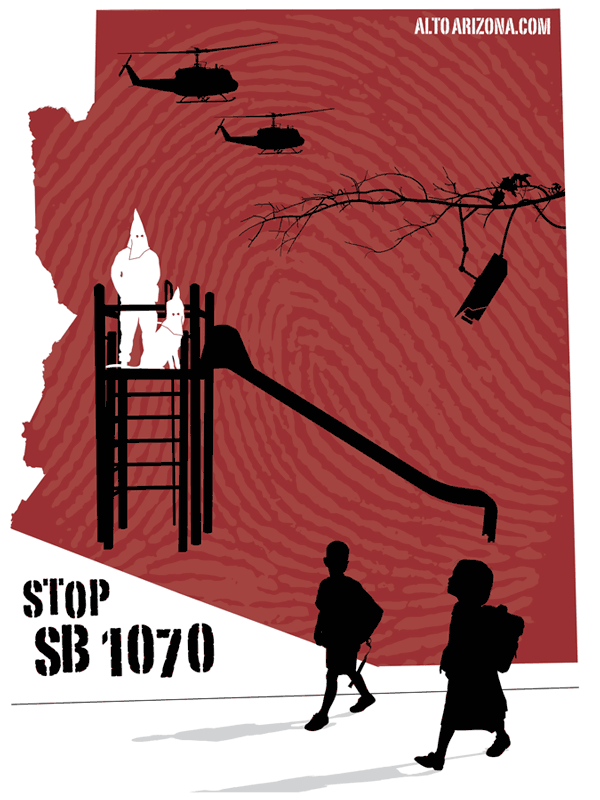
The similarities with what happened in Arizona’s past and the mob mentality today of many Arizonans is frightening. I just returned from a five day conference in Tucson and numerous participants of all colors referred to current events as a “Race War in Arizona.” It is doubtful whether most of them had ever read about the eighty percent law or about the numerous deportations.

Take the rhetoric of Arizona Governor Jan Brewer who this past week claimed law enforcement agencies had discovered “bodies in the desert” either “buried or beheaded” in addressing crime related to “illegal” immigration. The governor’s claim was disputed even by some of Arizona’s compliant press. Days before Brewer claimed that “illegal aliens” were muling transporting most of the drugs into the United States.

T.J. Bonner, president of the union representing border agents, responded “some illegal border-crossers carry drugs but most don’t. People with drugs face much stiffer penalties for entering the U.S. illegally, and very few immigrants looking for work want to risk the consequences.”

On the sane side, this past week, the _New York Times_ reported “Militia With Neo-Nazi Ties Patrols Arizona Desert.” This item was picked up by Arizona’s compliant media because it came from the New York newspaper. Arizona’s media has itself abandoned the art of investigative reporting.

The article identified Jason Ready as a neo-Nazi, the same Ready previously identified as a close associate of Arizona State Senator Russell Pearce, the author of SB 1070 and Maricopa Sheriff Joe Arpaio. All of them have close ties with the Federation of American Immigration Reform. Brewer and State Superintendent of Public Instruction Tom Horne, the author of HB 2281 that seeks to ban La Raza Studies from the Tucson Unified School District. Brewer and Horne have never dissociated themselves from this cabal.

When KGUN 9 asked me why we had not tried to convince Horne about La Raza Studies, which has all but eliminated the dropout rate of students taking their classes, I replied that I would if Horne would visit La Raza Studies program and test his assumptions. Incredibly, Horne replied that he did not have to observe the schools or listen to facts to form his ideas.

Arizona is a state without laws, without leadership, without an independent media. It has laws that allow psychopaths to carry guns, vigilantes to take the law into their own hands, and there is no such thing as inciting a riot, which is exactly what elected officials are doing today in Arizona.

With this mindset, with this lack of responsibility, there can be no resolution. Like the Mexican proverb says, “No hay mal que dure cien años, ni cuerpo que los resista” (There is no wrong that lasts 100 years, or body that can withstand it.) This makes a confrontation inevitable since there is a growing mass of people born here who are not afraid of the big bad wolf.

Poster By: Manuel Torres

A Post-Mortem: Obama and ACORN

By BILLY WHARTON

With the oil still flowing in the Gulf and two active wars in the Middle East, Barack Obama may be looking around for allies among progressives soon. If Vanderbilt University Press’ Seeds of Change is any indication, there won’t be many to be found among anti-poverty activists. Author John Atlas offers what he hopes will be a definitive treatment of the rise and fall of the activist group ACORN. The group’s rocky relationship to Obama is A central theme.

In the much-ballyhooed Obama-ACORN relationship, at least as Atlas presents it, ACORN plays the scorned suitor. In the introduction, he describes ACORN head Bertha Lewis as being “dismayed” at then candidate Obama’s refusal to recognize the connections he had forged with the group after being pressed by the right wing. “For Obama,” Atlas writes, “defending ACORN would play into the Republican strategy of diverting public attention away from his legislative agenda.” Yet, by not doing so, Obama may have contributed to the decline of his powerful ally while marking a symbolic distancing between his presidency and the progressive base that helped get him elected.

Seeds of Change is about more than Obama. Atlas documents ACORN’s rise from obscurity to a mass organization of 250,000 members effectively by employing the insider view gained during his 40-year career as an anti-poverty campaigner and lawyer. The formation of the group, he argues, was part of a counter-narrative emerging out the 1960s. Atlas holds up group founder Wade Rathke’s rejection of a ticket to Woodstock in favor of a community-organizing rally in Springfield, Massachusetts as a symbolic break from the “drop-out” ethos of the hippies. From here, Atlas documents Rathke’s innovative attempts to build an organization that drew mainly white middle-class organizers from universities and primarily African-American members from poor communities.

Along the way, there are some amazing victories. Atlas documents the group’s remarkable successes in the 80s in using the Community Reinvestment Act as a means to build grassroots organizing campaigns. Persistent community efforts broke down the wall of redlining, facilitating the flow of millions of dollars in private financing into poor communities. Simultaneously, in urban areas like the South Bronx and East New York, ACORN organized militant homesteading programs that empowered poor people to seize housing and reverse the tide of urban blight. Atlas’ presentation of Jacinto Camacho, a squatter who enters an abandoned building, renovates it and then holds out against New York politicians who wished to sell it to real estate speculators, brings the democratic impulse of this ACORN campaign to life.

Atlas’ treatment of the great debate that ensued over ACORN New York’s controversial support of the Atlantic Yards development project is less endearing. Here, it is author turned lawyer, as he seeks to justify the group’s decision to side with a real estate magnet using eminent domain laws for personal enrichment. Atlas does not attempt to frame the conflict as part of a larger struggle over real estate in the city or to mark the political distance traveled from the radical homesteading projects of the 80s. Instead, he summarized ACORN’s stand using the phrase so often employed to justify a political sell-out, “Unlike ideologues on both ends of the political spectrum, ACORN knew that the perfect is often the enemy of the good.”

The book closes with an examination of the tragic ending of one of the largest progressive groups in U.S. history. An embezzlement scandal involving the Rathke family, charges of voter fraud leveled by Conservatives and the media flash following the prostitution scandal, all serve to undermine the group’s mission of empowering the poor. The great tragedy of this decline, Atlas argues, is that it limited the possibility of creating the “maneuvering room” necessary for the Obama presidency to be transformed into something like that FDR’s New Deal administration. Like a tragic play, the scorned suitor faces their demise.

Seeds of Change is the latest offering in what is sure to be multiple post-mortem dissections of ACORN. There are contributions made here especially where Atlas provides readers with his insider perspective. However, questions remain. For instance, a serious examination needs to be made of the link between ACORN’s anti-redlining campaigns and the rise of the finance-capital in the US. Was ACORN the unwitting grassroots water-carrier for a rising financial elite? Did ACORN’s seeming breakthroughs in unleashing credit to the poor serve to paper over the class transformation being initiated by Reaganism? And, for those willing to take a counter-factual leap, could a different kind of class struggle have been carried forward in this critical period? Seeds of Change doesn’t answer these questions, but provides the useful bits of information needed to approach them.

Billy Wharton is a writer and activist whose articles have appeared in the Washington Post, the NYC Indypendent, Spectrezine and the Monthly Review Zine. He can be reached at whartonbilly@gmail.com

Source: counterpunch.org