The Right Will Not Go Away

By Rodolfo F. Acuña

A friend wrote that my piece on “Why the Right Will Win” overstated the strength of the Tea Partiers and the nativists. Arizona was not the rest of the country, dismissing Sarah Palin as an air head and the Tea Partiers as a passing fancy, punctuating his statement by saying that he tended to look at things through a more theoretical framework.

Based on my epistemological understanding, I could not disagree more. Past theories and accepted truths of the past cannot be applied to the period we are passing through. In the past the more intense forms of racist nativism subsided when economic times improved.

This is not the case today, times have changed.

If you haven’t read Jean Stefancic and Richard Delgado’s _No Mercy: How Conservative Think Tanks and Foundations Changed America’s Social Agenda_, you should. _No Mercy_ documents how the New Right Conservatives have set the country’s political agenda successfully targeting English Only, Immigration Reform, Race and Eugenics, the abolition of Affirmative Action, Welfare Reform, Tort Reform, and multiculturalism.

Since the Nixon years, the Right has consolidated its power through the funding of conservative think tanks and foundations and taken political power through buying elected officials and judges. Tax and inheritance laws have helped this accumulation of wealth and power even making their donations tax free. This year’s Supreme Court ruling that held that campaign finance limits on corporation violated their free speech delivered the final blow.

Reminiscent of Supreme Court rulings after the Civil War that held the 14th Amendment applied to corporations, shielding them from state regulation by giving them standing as persons, the Court’s 5-to-4 ruling in Citizens United v. Federal Election Commission holds that limiting the amount that individuals and corporations can contribute to political campaigns violates their free speech. The consequence is that the rich are free vote their dollars. Witness, Rupert Murdoch just donated a million dollars to the Republican Governor’s Association (RGA).

The August 30, 2010 issue of The New Yorker_ carried an article titled “Covert Operations: The billionaire brothers who are waging a war against Obama.” The title is misleading since like with Richard Scaife Mellon, the stakes are much higher than the Obama or the Clinton presidencies.

“Covert Operations” is about the Charles and David H. Koch, who have a combined fortune of thirty-five billion dollars, most of it in energy. They donate freely to the arts and right wing causes. They are not the ordinary billionaires, they own Koch Industries, the second-largest private company in the country.

They liberally fund right wing causes. According to _The New Yorker_ article, a Republican campaign consultant said, “The Koch brothers gave the money that founded …[the Tea Party Movement]. It’s like they put the seeds in the ground. Then the rainstorm comes, and the frogs come out of the mud—and they’re our candidates!” The Koch brothers are thus at the epicenter of the anti-Obama movement, playing the same role Scaife Mellon did when he funded the anti-Clinton campaign.

Charles and David Koch are ideologues. Like their father before them they were members of the John Birch Society. They are members of the Libertarian Party, a precursor of the Tea Party Movement. Conservative William F. Buckley, Jr. called the LB movement “Anarcho-Totalitarianism.”

“Public tax records show that between 1998 and 2008 the Charles G. Koch Charitable Foundation spent more than forty-eight million dollars” on political causes. The probability is that they gave a lot more. Much of the money is funneled through subsidiaries such as Americans for Prosperity which purportedly has controlling interest in the Tea Party.

The Koch brothers are in the energy business; they invest heavily in influencing energy policy—denying global warming. Through the organizations such as the Institute for Justice, they have funded suits opposing state and federal regulations.

Money buys considerable influence in the cash strapped Halls of Ivory where learned scholars sell their posteriors and write “position papers that are subsequently quoted by politicians and pundits.” The Koch brothers launched the Cato Institute in the 1970s and regularly buy studies from the Heritage Foundation that argue that “scientific facts gathered in the past 10 years do not support the notion of catastrophic human-made warming.”

According to the New Yorkers article, the jewel in the Kochs’s arsenal is the highly influential Mercatus Center at George Mason University. Fourteen of the twenty-three regulations that President George W. Bush placed on a “hit list” were concocted by Mercatus scholars.

The Kochs’ method is organized chaos. They and other chaos agents have disrupted the Obama Presidency. As soon as Obama was elected the Americans for Prosperity launched “Porkulus” rallies against Obama’s stimulus-spending measures. They orchestrated a Greek Chorus of Rush Limbaugh, Sarah Palin, Fox News and other conservative outlets. Arizona is the epitome of this organized chaos.

Americans for Prosperity has announced that it will spend an additional forty-five million dollars before the midterm elections. The objective is to slow down Obama’s momentum and make him ineffective.

Chaos is very important in this time that late historian Tony Judt called an “age of forgetting.” The agents of chaos are rewriting history, absolving George W. Bush, deregulation, praising the tax cuts, the wars and the bankers’ role in the economic disaster are all mythicized. In this scenario British Petroleum, Halliburton and the Kochs are the champions of Main Street. They are not Robber Barons but “Captains of Industry.”

The problem is much larger than Palin and the Tea Party. The Center for Responsive Politics reported that in 2009 the Robber Barons spent $3.47 billion lobbying government. This sum does not include what they can now legally contribute to political campaigns.

I don’t need theory to inform me that I am being had. As a Californian it is repugnant that states such as Alaska, Wyoming, North Dakota and a host of others can block legislation that will benefit the citizens of this state and favor special interests. I cannot forget that the U.S. Senators from states that have smaller populations than the San Fernando Valley receive ninety percent of their campaign financing from people like the Kochs.

I know enough about history to recognize Robber Barons. I know enough about history to know who my enemies are and know that I cannot compromise with them. I know enough about history to know that a silver bullet will not solve our problems. And I know that Palin and her ilk are part of the chorus and not the conductors.

Four Decades of Survival, Resistance, and Barrio Organizing: A Reflection on the 40th Commemoration of the 1970 Chicano Moratorium

By Francisco “Chavo” Romero

It was 40 years ago on a bright, beautiful Saturday morning in which nearly 30,000 people marched against the Vietnam War, a march that flowed through East Los Angeles, down the Whittier Boulevard stretch, a marvelous, inspiring time for the Chicano Movement. Children, the elderly, men, women, and young vibrant activistas, had come from other cities, states and beyond to march at this historic event. Reverberations of the chant, “Raza Si! Guerra No!” traveled throughout and around East Los.

That wonderful moment, was brought to a sudden halt when hundreds of Los Angeles Sheriffs and LAPD descended upon a peaceful, organized community action at Laguna Park (now Ruben F. Salazar Park), where families danced to corridos and listened to powerful political speeches about the injustices in the barrio and the atrocities of La Guerra en Vietnam by movement leaders. Their pretext was that a “suspect” had allegedly stolen a six pack of beers from a nearby liquor store and had run into the park. What transpired next was a brutal assault by armed, baton-swinging, and tear gas-shooting puercos.

My heart aches, still, when I watch the old footage of the Sheriff Pig smashing down a young woman with his baton, striking her full force at her neck and knocking her to the ground unconscious. The first time I saw this I was sitting in my first ever Chicano Studies class at the local community college and I was so enraged by those images that I slammed the desk with my fist. That was over 15 years ago, when I joined El Movimiento.

I clearly recall my first ever political marcha against California Governor Pete Wilson’s Proposition 187. I had recently joined M.E.Ch.A, el Movimiento Estudiantil Chicano de Aztlan, and they called for a demonstration to protest Prop. 187 by marching from Ventura Community College down to the Ventura County Government Center… I proudly carried a placard that I made the night before, which denounced the racist attack on my gente. I also remember that it was that day, a couple of fellows, now my great comrades, the Moreno brothers, gave me a flyer to join them in an organizing meeting for the National Chicano Moratorium Committee. It was a planning session to mobilize for the following year’s 25th Commemoration of the August 29, 1970 East Los Angeles historic march. I grabbed the flyer and glanced at it.

The following week, I went ahead and joined them for the meeting at the old United Farm Workers’ union hall located on north “A” Street. I sat in the back of the room on a squeaky old fold up chair, and then listened in. I was immediately drawn to the sharp analysis that was being presented about how important it was to continue to organize the Chicano Moratorium, because it was one of the most critical moments in La Raza’s history on this side of the Frontera Falsa. After ending their week-long hunger strike against Proposition 187 at the Placita, within the center of the City of Oxnard, student leaders and other activists formed the Oxnard Chapter of the National Chicano Moratorium.

From those days on, many of us have worked tirelessly to keep the struggle moving forward, to keep El Movimiento alive in our town, Chiques, Califas. The only way, that many of us have been able to keep a steady rhythm and survive the ebbs and flows of our revolution, is through collectivism, accountability and through organization. Over 15 years ago, I joined Union del Barrio and my entire life changed; it has been this humble, grassroots, barrio-grounded organization that has inspired me to wake up every morning and fight! I recall picking up Voz Fronteriza and ¡La Verdad! newspapers and I would read every single article, not once, but twice and sometimes even a third time. I remember reading information that I had never read anywhere else before, especially the analysis and perspectives on colonialism and liberation.

In 1994, I joined El Movimiento, and in the early dawn of New Years of that same year, the Ejercito Zapitasta por la Liberacion Nacional (EZLN), the Zapatista insurgency in the state of Chiapas, Mexico declared, “¡Ya Basta!” The armed insurrection of indigenous peoples’ refused to remain silent, so they “wore masks to be seen and shot rifles to be heard,” and millions within Mexico and from around the world joined in this Peoples’ War against the North American Free Trade Agreement, Neoliberalism and Capitalism.
It was an inspiring moment in time. A spirit of resistance that had for a long time been silenced, it seemed, had spilled onto the streets. Revolution was in the air once again.

In reality, every year since the mid 1970’s, during the height of what is now known as the Black Power and Chicano Power Period, which encompassed the years of 1965-1975, there has been an ongoing, arduous trek to keep the struggle for liberation moving forward, despite all odds. We have been walking this centuries old path of resistance for more than 518 years…

The U.S. Government and the Federal Bureau of Investigation’s counter-revolutionary attack, COINTELPRO, the Counter Intelligence Program, was a systematic, scientific assault to destroy any semblance of independent revolutionary activity within what is, now, U.S. territory. COINTELPRO was responsible for the monitoring, infiltration and disruption of organizations and individuals who were actively posing a basic threat to the hegemony of Imperialism in all its forms. Socialist, Communist, Black, Indigenous Peoples, Chicano/Mexicano and Puerto Rican peoples, Anti-War, Women’s Rights, student groups, among others, were targeted to be, as then FBI Director Hoover stated, “exposed, disrupted, misdirected, discredited, or otherwise neutralized.”

Vocal leaders of these liberation and social movements were targeted; many were assassinated, including Malcolm X, Fred Hampton, and scores of other activists and organizers, including more moderate “civil rights” leaders, such as Martin Luther King, Jr. Countless potential revolutionaries were “neutralized”, via imprisonment, and many fell to the heavy drug importation into poor working-class communities. Specifically, the American Indian Movement, the Black Panther Party, the Brown Berets, the Crusade for Justice, the Young Lords, and an array of other revolutionary-leaning and anti-colonial formations across the landscape were targeted.

Other methods of counter-insurgent measures were implemented.

From the mid 1970’s and throughout the 1980’s, the radical, independent and revolutionary forces within the U.S. were marginalized. The mass influx of the Democratic Party institutionalized effort to contain and absorb any remnants of independent social and left-oriented political alternatives went into full effect. La Raza Unida Party process of creating a third party was nearly completely dismantled. The eighties, then, became “The Decade of the Hispanic”, where mainstream, mainly assimilationist advocacy-type agencies spread like wildfire across Aztlán-Occupied Territories and beyond. For hundreds of activists, the berets and radical buttons that read, “Chicano Power! Y Que!” slowly morphed into suits, ties and swinging leather business briefcases. With the nice pens y todo.

Next came the increased “professionalization” of activism and organizing that spread throughout and within movement socio-political spheres. The gradual institutionalization and containment of the language, study and struggle of revolution subtly gave way to the language of “social justice” and “empowerment” campaigns. The fight for liberation withered from working-class led struggles within the independent and radical movements in the community and on school campuses, into “policy-change” and reformist measures led by “trained community organizers”. The liberation and anti-colonial struggle was repackaged into sanitized, donor-friendly language that would make it through the first review of applications submitted for foundation and corporate funding. Some non-profits, a very small handful, have been able to weather the ruling-class constraints and are finding a delicate balance of maintaining accountability to the community, a balance that is sometimes overwhelmingly difficult to sustain. The reality though, is that the vast sea of these advocacy and empowerment-type agencies, by and large, are trapped within the framework of policy-change and in the main are service-oriented. Organizing for self-determination and liberation was deemed impractical.

It was during the 1980’s, where those that survived the onslaught of attacks by the state, those that met in backyards, in homes in the barrio, on the street corners and in the pintas, that decided, not to give up on El Movimiento, that refused to abandon the basic principles of dignity and devotion to revolution.

So, we met.

Slowly but surely, we began to rebuild.

Out of the ashes, we rekindled the fire, 518 years old… fanning the flames of resistance.

So, during the 1980’s our people defended and supported the Sandinistas, the Farabundistas. We boycotted Coors and fought and fasted in defense of Chicano Studies programs. We reconvened the Chicano Press Association, now known as the Raza Press and Media Association.

The year 1990 arrived and we marched with over 20,000 Raza for the 20th commemoration of the Chicano Moratorium. We walked, ten thousand of us, against 500 Years of Oppression to the Frontera, La Linea en Tijuana y San Ysidro. We watched L.A. burn again, in the fires of injustice and oppression. We came out against Proposition 187. We clamored, “Ya Basta!” We marched for the 25th commemoration of the Chicano Moratorium. We resisted against Propositions 209 and 227. We walked in Tucson against the 150th year of U.S. occupation of our lands. The turn of the century came… and we survived and resisted. All of it.

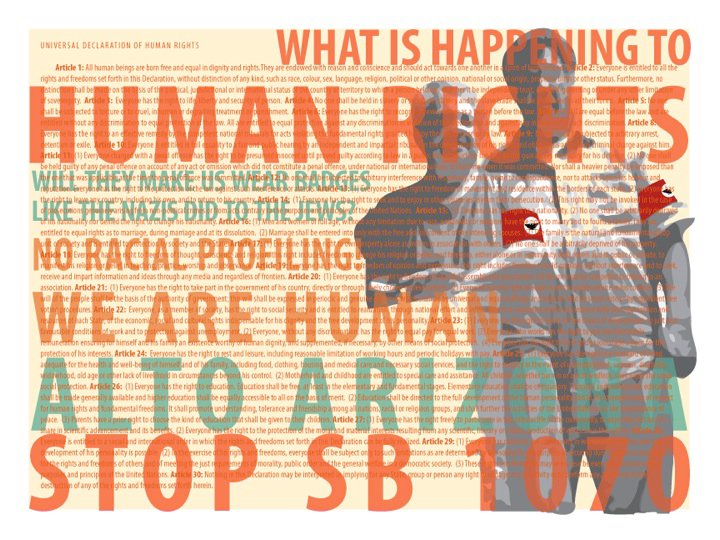
In this first decade of this millennium, we have once again, as a people, responded to the attacks against our gente, los trabajadores y nuestras familias. The politicos and the ruling elite launched their Secure Communities, 287 (g), HR-4437, and recently SB-1070. Now, they are spending millions of dollars, sending more troops to the border and more Migra/ICE into our barrios and workplaces. The police brutality continues. They continue to build prisons, and we are filling them up. They continue to defund education and social programs, and continue to fund wars.

The oppressors and their apologist collaborators have come at us with everything they have. Yet, we have endured. The painstaking task of daily activism and organizing, a lifetime commitment that many of us have made, takes its toll; nevertheless we trek on, forward always.

On Saturday August 28th, yesterday, on the historic march for 40th Commemoration of the Chicano Moratorium in Los Angeles, we walked down the streets clamoring, “Raza Si! Guerra No!” There were only six hundred of us or so, but, we marched with our heads held high. We walked with dignity.

Today, Sunday August 29, 2010, here in Chiques, we will unfurl the banners of resistance, dignity and an uncompromising commitment and love for Nuestro Pueblo y La Humanidad.

Que Viva El Moratorio Chicano! RAZA SI! GUERRA NO!